Saturday, January 28, 2012

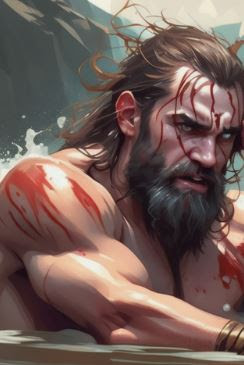
New 1E/OSRIC Character Snapshot

================
AD&D Record Sheet
================

Player: Matt
Character: Elandril (Elan)
Race: Half-elf
Class: Ranger
Age: 37
Height: 5 ft 7 in.
Weight: 135 lb
Eyes: Hazel
Hair: Brown, shoulder-length
Sex: Male
Deity: ?

Level: 2 (limit 7)
XP: 3,000 (needs 4,500)

Strength: 17 (+1 hit, +1 dmg, 1-3 minor test, 13% major, +50 enc)
Dexterity: 12
Constitution: 16 (+2 hp)
Intelligence: 14
Wisdom: 15 (+1 mental save)
Charisma: 9

Hit Points: 24
3d8+6
7,3,8+6 = 24

Armor Class: 7 (leather + shield)
THAC0: 19

Alignment: NG
Languages Spoken: Common, elven
Weapon Proficiencies: Long sword (specialized), short bow

WEAPONS
Long sword (#AT 3/2, +2 to hit, 1d8+3/1d12+3)
Dagger (-1 to hit, 1d4+1/1d3+1)
Short bow (1d6, 50 ft range inc., ROF 2)
(+1 dmg vs. evil humanoids/giants, see below)
(Note: two-handed = +0 primary, -5 off-hand, long sword/dagger)

SAVING THROWS
Aimed Magic Items: 16
Breath Weapons: 17
Death, Paralysis, Poison: 14
Petrification, Polymorph: 15
Spells (unlisted): 17

SPECIAL ABILITIES
+1 damage vs. evil humanoid or giantish opponents (melee only)
Only surprised on 1 on 1d6; surprises others 1-3 on 1d6
(Note: add’l +1 surprise when carrying 85 lb or less)
Tracking (90% base success in rural settings, 65% in urban or dungeon settings)
30% resistance to sleep and charm spells
Detect secret doors 1-2 n 1d6, concealed doors 1-3 on 1d6
Notice secret doors without trying 1 on 1d6 within 10 ft
Infravision 60 ft

EQUIPMENT
Leather armor (-2 AC, 120 ft move)
Medium shield (-1 AC from two opponents/round)
Quiver, 24 arrows
Cloak
Tunic + breeches (woollen)
Belt
Soft boots
Backpack
Bedroll
Trail rations (4 days)
Waterskin
Flint and steel
Silk rope, 50 ft
Small steel mirror
Small belt pouch
Chalk, 10 pieces
Caltrops
15.17 gp

NOTES
Enc: 83.5 lb (loses ranger surprise bonus, reduced movement over 85 lb)

Solitary personality; formally trained as a hunters/woodsman, home was pillaged/destroyed, some ten years ago.  Respects laws/society and is generally a benefactor.

Sunday, February 27, 2011

Jendrick's Challenge, part 2

Tonight I got to play Skype session #2 - a week later than originally planned, but a good time nonetheless. The first ten minutes were spent sorting out technical issues: audio static due to a bad mic and the inability to get both our videos working at the same time. After Tracy switched back to the mic he used previously, the audio was great - better than last time, actually, as we didn't incur any spottiness throughout the duration of the two-hour game. Since we only managed to achieve one-way video, we elected to go without. The video is nice, but not having it wasn't really a detriment - not for our two-player game, at least.

We picked up outside the Sign of the Three Crowns, where Jendrick and Rosamund parted for the evening. They reconvened at sunrise in one of Sturnheim's gardens, though when Rosamund arrived, she was accompanied by Tregar, the dwarf hunter that Jendrick had spoken to the previous day. Rosamund had surmised that Poot's slaying was somehow related to Sturnheim's lost treasure, and wanted Jendrick and Tregar to help her uncover the truth.

As the story goes, some forty years prior a caravan carrying a large segment of Sturnheim's wealth was plundered by unknown robbers, crippling the town and severing its trade with other nearby settlements. Shortly thereafter, a party of eight adventurers struck out to find the lost caravan. Four met an untimely death along the road; of the four that returned, two left Sturnheim and two remained in the village. Of those that remained, one supposedly went mad and eventually fled; the other was Poot.
Rosamund was hesitant to place much trust in Sturnheim's militia, for its captain, Valdar, was the son of a warrior named Kesor, one of the surviving adventurers that departed and a notably evil man. As such, Jendrick led his friends to the constabulary where they inquired about the confiscated stone sword. The guards allowed them to examine it, though not remove it from the premises. When Jendrick asked if Poot's house might be searched, the men agreed, with one soldier accompanying the trio there personally.

The door to Poot's house was adorned with a broken and decrepit lock; inside, the man's personal effects were strewn about haphazardly. A half hour of searching revealed an iron ring that was strangely warm to the touch (which the guard promptly collected), and a telling note scrawled upon a sheet of parchment:
P -

Meet me in the old alley tonight and bring the key. I have ascertained its origin and purpose, and the location of the lock.

-V
Rosamund passed the note to Jendrick, who promptly handed it over to the guard, much to the girl's displeasure. The trio then returned to the constabulary to question the jailed bandit, who revealed nothing. Back outside, Rosamund and Tregar surmised that the note may have been scribed by Valdar, which would implicate that Valdar himself had orchestrated Poot's slaying. With no further leads, and without possession of the "key" (the stone sword), the trio left town and began traveling along the Forsaken Road (the road that Poot had referenced in his dying words).

After an hour, the friends encountered a mounted knight in rusted field plate armor; he carried a lance bearing a tattered blue pennant and sat upon a weathered nag. The knight, obviously a venerable man by his voice, proclaimed himself guardian of the road, refusing to let anyone pass until they bested him in a duel. Seeing that Jendrick rode no horse, the knight dismounted and drew forth his longsword. The two crossed steel, and after Jendrick twice scored hits between his opponent's armor, the old knight yielded and allowed the trio to pass.

Jendrick offered the man his [magical] aid, treating him with the utmost respect and inquiring as to his origin. In the ensuing dialogue, Jendrick learned that the man was none other than Sir Nycklos of Roeh, the surviving adventurer who supposedly had fled, and indeed was quite mad (or at least very senile). The party pressed on, and as the afternoon waned came upon an unusual rock formation standing near the road. Jendrick noted that the boulders looked vaguely like a dragon, and Rosemund linked this to another of Poot's deathly phrases, "south at dragon."

Before they could go further, a grunting noise behind the rocks revealed a hulking man devouring an uncooked squirrel, with the carcasses of several more at his feet. This man declared himself "Ahrne," and though his speech was rather primitive, he wore two most curious items: a stone shield, strapped to his back (his "armor") and a valuable gold necklace bearing a medallion branded "Sturnheim Caravan Company" and dated 46 years ago. Jendrick asked to be taken to the place where Ahrne found his strange treasures, and Ahrne readily agreed... for another squirrel.

That's where we left it; though there wasn't much combat (the duel with Sir Nycklos hardly counts), the plot has definitely started to unfold. In addition, having a paladin as the lone PC creates an interesting dynamic in almost every NPC encounter. For example, a character of any other class would likely not have turned the note found in Poot's house over to the guard; Jendrick, however, chose to do just that, drawing scorn from Rosamund and arguably turning a valuable piece of information over to a questionable source. On the other hand, Jendrick's chivalrous demeanor served him well in the encounter with Sir Nycklos, and has helped him establish a valorous repor with numerous individuals in Sturnheim.

Looking forward to seeing how the rest of the adventure plays out, and particularly what companions Jendrick brings with him when finally he arrives in Hommlet.

B/X Scenario: Halflings vs. Ogres

I stumbled across this post while poking around on Dragonsfoot the other day, and really enjoyed it. The author created a one-off scenario where a band of ogres had been terrorizing a halfling shire, and the lone player controlled a party of ten 1st-level halflings to track down and eliminate the threat. This was a B/X (D&D Basic) adventure, so the halflings were just halflings.

In any case, the author goes on to provide specific stats for each of the ten hin (along with starting money and equipment) along with the individuals' roles within the village. Then he recaps the encounter itself, recounting every die roll and tactical decision made by both sides. I found the whole piece to be highly entertaining and fascinating in its elegance and simplicity.

For a while I've felt like Basic (or something in the realm of "not-quite-Basic," like the Basic Fantasy RPG) is something I could really get into someday, under the right set of circumstances. Every time I read something like this it just reinforces that notion.

Friday, February 18, 2011

AD&D + VoIP: The adventure begins...

VoIP may forever change the way I play D&D.

A good friend and I got together this evening to play a quick OSRIC session using Skype. He already uses video and voice for gaming regularly, but for me, this was a first-time experience. It practically couldn't have gone more smoothly.

The main purpose of the adventure was to acclimate Tracy's new character, a paladin named Jendrick Tannerson (son of a tanner - fitting) to the campaign in place of Greenleaf the druid (now officially retired). Though we only ended up playing for about an hour and a half, much was accomplished. We're planning to reconvene Sunday evening, and I could see it taking three to four of these brief, online sessions to wrap up Jendrick's inaugural adventure, which should have him ready to join the rest of the tabletop cast in Hommlet, the next time we play.

The module we're using for our online foray is Fighter's Challenge, modified to fit within the ongoing campaign. Jendrick, traveling the countryside in search of personal enlightenment and general do-gooding, made his way to Sturnheim and befriended a lovely young lady named Rosamund, who instantly became enamored with the budding knight. Jendrick, naive in the ways of romance, graced her with awkward conversation in the Sign of the Three Crowns (the local inn), and also parleyed with Tregar, a young dwarven hunter newly returned from guard duty for a local caravan.

Jendrick offered his services freely to Tregar on his next hunt (for which Tregar intends to depart in two days' time) and was quickly obliged. Later in the evening, Jendrick and Rosamund happened within earshot of a scuffle in a dark alley while walking the streets of the village, with Jendrick rushing to the aid of an old man who seemingly was being attacked by three others. The assailants fled and Jendrick pursued, weighted down by his mail and only able to keep pace with the slowest of the bandits, that one lugging along a heavy greatsword that appeared to be made of stone. Jendrick managed to catch and pin the man, and Rosamund summoned a trio of the town's militia.

By the time help arrived, the victim of the attack, a frail old man that the militia referred to as "Poot," had succumbed to his wounds and died in the alley. Two of the militia escorted the captured bandit away to their captain whilst Jendrick assisted the third soldier in carrying Poot's body, along with the stone sword, to the church of St. Cuthbert. Jendrick and Rosamund headed back to the inn (the latter's romantic mood quite shattered), though en route the girl revealed that Poot had uttered some strange phrases before he died:

"My house... parchment... sword is the key. Forsaken Road through hills... south at dragon."
That's where we left it. The session was a blast, brief though it was. AD&D/OSRIC continues to impress me in all its nostalgic elegance. When chasing down the bandit, Jendrick's initiative bested the pursuant by four segments, allowing Jendrick to close the thirty-foot distance between them and make an attack roll to trip the bandit with his shield. A minor Strength test to pin the man; a Strength check to maintain the hold until the guards arrived.

Even better was being able to play via Skype, using both video and voice. Tracy has amazingly good attendance for our tabletop sessions despite living more than an hour and a half away; that said, making the drive up for an hour or two of solo gaming isn't a reasonable expectation for anyone. Aside from a few audio glitches that forced us to reconnect (took all of 30 seconds), it was just like having him in the room. We used the honor system for die-rolling, but even if I'd wanted validation we could easily have used an online roller.

Also nice was having my laptop - and all my notes and resources - right at my fingertips. I intentionally don't use a computer when gaming in person, but as it's nearly unavoidable for remote play, I was happy to have it. Dropbox and Skype file transfer make sharing character sheets instantaneous and trivial. As we were wrapping up, we also took a few minutes to check out Dabbleboard, a potential all-in-one solution for online D&D: it provides a fast and easy-to-use whiteboard for diagrams and maps, along with free audio, video, and chat for up to 20 people via tokbox.

My only regret is that I didn't try this sooner. VoIP will enable me to play D&D with my closest friends across the country, people that I grew up on this game with but that I haven't actually been able to play with in years. For now, the next session is just two moons away...

Saturday, February 5, 2011

T1, part 4: In the Arms of the Enemy (literally)

Last night's game was both a complete disaster and the perfect setup for part 5. Here's what happened:

Midday. With the core of the party still ailing from its previous foray with the ghouls, Gulwar was left recruiting new help in the Inn of the Welcome Wench while Rylin the halfling resumed his job as a line cook. A druid named Greenleaf befriended the pair, and not a moment too soon: before they could even begin to discuss their plans, the mercenary Zert came storming into the taproom, trailed closely by Turuko and his hulking-yet-dimwitted arm-for-hire Kobart. Behind that pair meandered a handful of villagers. Spugnoir quietly pulled his spellbook up over his face as Zert tossed the contents of a bloodstained, burlap sack at Gulwar, proclaiming:

"Death seems to follow you, adventurers. Perhaps you'd have done better to let restful bodies lie, for now WE will be forced to finish the work that you've started to ensure the lasting safety of this village."
From the bag rolled the severed head of Ellimorell, and the patrons gasped in horror. Zert went on to explain (menacingly) that the bodies of the fallen, hauled back to Hommlet by the PCs, had risen as ghouls and terrorized several farms before being slain by none other than Zert himself, along with his new allies. The trio accused Gulwar's party of endangering the village, challenging the townspeople to unite against such recklessness, and though some of the villagers nodded their agreement, just as many stood to the PCs' defense. Finally, Gulwar declared that he and his companions would leave the very next day, if that was the desire of the village. Zert seemed satisfied at this and left, accompanied again by Turuko, Kobart, and a particular farmer...

Gulwar stepped outside and followed the foursome toward the traders establishment, though once there he found only the warriors. Unable to hear their conversation without compromising his identity, he waded out to the northernmost farmhouses until he located the farmer. To the farmer and his family he solemnly apologized for any distress he and his companions may have caused, and offered them a few gold coins. Obviously torn, the farmer admitted that Zert and Turuko had paid him off (only a few silvers) to go along with their story and serve as their witness.

Armed with this new information, Gulwar gathered Rylin and Greenleaf (who in the meantime had taken it upon himself to bury the disembodied head of his player's former character) and visited Canon Terjon at the church of St. Cuthbert. The canon was distraught to learn that the bodies may have been stolen from the church's mausoleum, and bade the PCs to uncover the truth behind Zert's accusations. The village elder, too, supported the PCs in the name of upholding the church and extinguishing any potential for widespread panic or uprising in Hommlet.

...

So, at this point, the PCs are really itching to locate Zert and his new allies, who curiously haven't been seen since Gulwar observed them at the traders establishment. Back at the inn, Rylin uses inside resources to locate Zert and Turuko's rooms, and the party sneaks upstairs to infiltrate both. The rooms are completely cleaned out, with no personal effects remaining. Ostler (the innkeeper) didn't know that either of them were leaving, though as their dues have been paid for several weeks in advance, to him it hardly matters.

Why would Zert and Turuko bother themselves to poison the village against the PCs just to turn around and leave? The only semi-plausible explanation seemed that the trio was looking to reclaim the PCs' local renown for themselves by plundering the moat house on their own. And so, the next morning, after the village elder (backed by Rufus and Burne) publicly exonerated Gulwar and his friends of any wrongdoing, the characters re-hired Spugnoir and set back out for the ruins...

...

Seeing no sign of their accusers above ground, the party quickly descended to the dungeon level, then down the chute to the [now empty] ghouls' chamber. They forged ahead into unknown corridors, and all was going smoothly until they stumbled upon a room brooding with dog-faced gnolls.

A melee ensued, and though the PCs (outnumbered more than two to one) managed to gain a quick upper hand, Greenleaf made the untimely mistake of dispelling his magic entanglement upon the enemies, and the gnolls captured Rylin and the druid, while Gulwar remained hidden under his cloak of elvenkind and Spugnoir fled. The gnolls marched the captives down another corridor, past a series of human guards wearing black armor that bore the yellow-eye insignia, and up to a dark-haired man adorned with a staff and mace who was obviously their leader (all the enemies referred to him as "Master").

The master offered Rylin and Greenleaf their lives in exchange for their indefinite service, and the pair reluctantly agreed (for the other option was death). Gulwar, still concealed, located Spugnoir and attempted to exit back up the chute, only to find it closed and barricaded. With some effort, the pair managed to circumvent a single human guard and discover an alternate way out: a tunnel under the moat that exhaled into a rocky outcropping above ground, a quarter-mile disposed from the moat house proper.

That's where we left it, though before the session broke we confirmed that Gulwar and Spugnoir returned to Hommlet safely and relayed their tale to the village elder. And that there still was no sign of Zert, Kobart, or Turuko...

XP

Not much: one gnoll defeated, and three vials of holy water, an unknown potion, and an unknown clerical scroll returned to the village safely (not to mention just one out of three characters). I'm not planning to disposition experience for this session; I'll just lump the above in next time around. I'm still waiting for the group to have a break-out adventure both in terms of in-game success and experience earned (which tend to go hand-in-hand), and don't plan to reevaluate the AD&D experience system until at least after we're done playing the module - it's too hard to make a fair assessment with so much still left unresolved.

DM's Commentary

Had the gnolls not preferred capture over the outright slaying of the PCs, the characters would probably all be dead.

The party needs more firepower. It's interesting to note the change in dynamic since the campaign started with regards to NPCs available for hire. At the onset, Hommlet was enjoying an influx of adventurers and mercenaries in response to hearsay of local bandits, so much that the PCs were actually being approached by individuals looking for work. Weeks later, the bandits are gone, and many have died or been grievously injured since the adventuring population became saturated. Now, the remaining characters have few places to look for help.

My gut feeling is that our next session will write the end to the party's chapter in Hommlet. The urgency of the PCs' situation is suddenly very much increased, with two characters held captive and the realization that a substantial evil force has taken up residence below the ruins. The party will need careful planning, men-at-arms, and the resources of the village to rescue their friends and close the door on the moat house for good.

Will they succeed?

Thursday, February 3, 2011

Things to remember in combat

These are as much for my own benefit as anyone else's...

Surprise (d6): 1 = surprised for one segment; 2 = surprised for two segments; 3-6 = not surprised. Dexterity can negate surprise segments for individual characters.

Attacking into Melee: If an attacker has multiple adjacent opponents, the target is determined randomly. The same applies when attacking at range against "engaged" opponents.

Charge: A charging character gains +2 to hit, but if the defender's weapon is longer than the attacker's, the defender can attack first. A character can only "charge" once/10 rounds.

Fleeing: Fleeing characters immediately draw an additional attack from adjacent opponents at +4 to hit.

Parrying: A character who parries cannot attack, but may subtract his or her "to hit" bonus from his or her opponent's attack roll.

Invisible Opponent:
An invisible opponent can only be attacked if the general location is known, and the attack is at –4 to hit.

Prone Opponent: Attacks against a prone opponent negate the benefit of a shield, negate dexterity bonuses, and are made at +4 to hit.

Concealment: Concealment is anything that obscures an opponent’s vision, such as tree limbs or smoke, but does not physically block incoming attacks. The GM must decide whether the defender is about a quarter (-1 to AC), half (-2 to AC), three-quarters (-3 to AC), or nine-tenths (-4 to AC) concealed.

Cover: Cover is protection behind something that can actually block incoming attacks, such as a wall or arrow slit. Cover bonuses are as follows:

  • 25% cover: -2 AC
  • 50% cover: -4 AC
  • 75% cover: -7 AC
  • 90% cover -10 AC

Tuesday, January 25, 2011

OSRIC returns

Setting up to run a game on Saturday, Feb. 5. Amiculum, Gulwar, Rylin, and Ellimorell's grisly corpse have unfinished business in the Village of Hommlet... and of course, the ruins of the moathouse:


Will goodness and valor prevail, or will Gulwar and Dravin's retardation foil the party to its doom?

Monday, April 26, 2010

DM screen modifications


My 4th Edition DM's screen is great at being a physical barrier between my players and my notes when running a session; unfortunately, its contents aren't very useful for 1e/OSRIC. This evening I worked out a solution to that problem...

Sunday, April 25, 2010

AD&D record sheet updated

I made some minor edits to the character sheet we've been using to better support the rules cleanup I've instituted for our game. A permanent link is also available on the right.


Prior to our next session, all players will be required to copy their character to the updated sheet for consistency going forward. This should only take a few minutes, and the effort will be worth 200 XP each.

--Matt

Saturday, April 24, 2010

Backstab and Turn Undead

After a bit of research today, here are rules clarifications on two abilities we debated a bit during last night's game:

  • Backstab - To backstab, the intended target must be unaware of the thief (this typically requires at least a Move Silently check). The target need not be "living," but it must have a discernible backside (for example, slimes and beholders cannot be backstabbed). A successful backstab renders the victim instantly aware of the thief, automatically foiling subsequent attempts. Also remember that thieves gain +4 to hit when backstabbing.
  • Turn undead - This ability can only be attempted once per encounter, per cleric.

T1, part 3: A Feasting of Ghouls

We played our third session of The Village of Hommlet last night, with a cast of Gulwar, Amiculum, Ellimorell, and Rylin, halfling thief and newcomer to the party. The characters have found their local renown surging of late, and as such have been approached by a steady stream of prospective mercenaries and hire-ons. Rylin, hitherto working as a line cook in the Inn of the Welcome Wench, was one of these. With Dravin still ailing from the party's previous expedition (fell ill after being bitten by rats in the moat house), the PCs also employed the hulking fighter Kobart (arranging a wage of 5 gp/day through his associate, Turuko) and the self-proclaimed scribe, Spugnoir.

At the onset of the session, an ore trader arrived in Hommlet bearing the bodies of a local huntsman and his two adolescent sons, who had departed east along the road the previous morn in anticipation of Ulaa's Hunt, a scantly-recognized holiday in the region. The hunters' wounds indicated a grisly attack, and after [finally] meeting and consulting with Rufus at the estate of the village elder, the PCs chose to investigate. At dusk, they noted the local custom of food-sharing by candlelight in the wake of a significant death.

The next morning, the PCs visited the traders' establishment to replenish supplies before heading out, and on their way they encountered Rogar; curiously, the man had a long and newly-drawn scar across one side of his face. The warrior admitted to fighting, but would say no more on the matter. After he and Gulwar mutually apologized for their previous dispute, Rogar agreed to accompany the party east. Their venture lasted two days and uncovered no leads in relation to the murders, though the characters did encounter a clothier and his family (a wife and two cousins) traveling west, and escorted them to Hommlet.

Upon their return, the PCs and their three hirelings delved back into the moat house, opening a pair of locked doors on the dungeon level and discovering an assortment of armor, weapons, provisions, and a large pile of black capes and tabards bearing an unknown insignia: a yellow eye wreathed in flames. Intrigued, the PCs set shields face-down on the steps and piled them in front of the doors to serve as makeshift alarms, then proceeded to the secret chute uncovered in the torture chamber during their last visit.

Rylin scouted the bottom, some 30 feet down, noting what the group believed to be more zombies amid an earthy room lined with six-foot alcoves (crypts). After experimenting with various means of setting fires down below using two kegs of brandy found in the store rooms (these were marked as being from Dyvers), the party descended the chute, ready for battle.

That's when things got interesting. The zombies, four in all, converged on the friends immediately, paralyzing Rogar and Amiculum, to the group's horror. The melee then degenerated into a gruesome bloodbath and feasting for the ghouls (for that's what the creatures truly were): Rogar was half-eaten alive, Ellimorell was slain, and Amiculum fell, bleeding and burned. Kobart failed a morale check and fled up the chute, but Spugnoir cast sleep and the warrior plummeted back down to the stone floor, landing in a broken heap.

In the end, Rylin and Gulwar defeated the ghouls, the latter saving Amiculum from within hairs of death with his magic. Kobart and Spugnoir lived (Spugnoir actually never descended the ladder), and the survivors (five in all) hauled the mangled corpses of Rogar and Ellimorell back to Hommlet. That's where we ended.

This was an eventful session to say the least, and it ran great, even if the outcome was less than ideal for the PCs. I inverted armor classes on the fly, eliminating hit tables in favor of hit bonuses, and the change was well worth the minor up-front effort. There's not a ton more I need to streamline at this point, though I do need to make some alterations to our character sheet to avoid any confusion going forward.

Right now, I'm unsure if I'll make the move to C&C or just stay with OSRIC. There are cases for both at this point, though I'm probably leaning a bit toward the latter. I just need to think about it more in the coming days.

Not much XP was gained from this session. I'd already decided to grant Amiculum and Ellimorell a 1,000 XP boost, as in retrospect it was somewhat unfair to allow Dravin and Gulwar to begin the campaign so much higher. The party is also granted 1,000 XP for the cloak of elvenkind found in the previous session, though this award will only be split by the characters that played in that game. For this session, the ghouls are valued at 352 XP, and this award will be split equally between Rylin and Gulwar.

Updated XP totals should be reflected on the site shortly.

Matt

Sunday, April 18, 2010

Rules Update

I've been spending time today researching the potential impacts of transitioning my game to the C&C rules. Since I found one or two things that might be detrimental to the existing characters, I've decided I need to discuss Castles & Crusades with my players in more detail before making a switch. In the interim, I'm considering the following changes to 1e/OSRIC:

  • Upward AC. PC base to-hits would equal 20 - THAC0. Monster to-hits could then equal their hit dice. Calculating AC is trivial: just add to (instead of subtract from) the base of 10. Doing this math up front should make attack rolls much simpler, with no ill effects, and eliminate "to-hit" tables.
  • "SIEGE" checks for task resolution. This would replace AD&D ability checks (or the lack thereof) and saving throws with a standard "d20 + modifiers vs. target DC" mechanic. This is the meat-and-potatoes of Castles & Crusades, and seemingly makes task resolution a breeze. No more wondering what to roll, or if you want a high or low result. Of course, a great complement to the SIEGE system is...
  • Standard ability score bonuses. 13-15 = +1; 16-17 = +2; 18-19 = +3. This makes mid-range scores more relevant, and bonus thresholds easier to remember.
For next session, I'll likely implement only #1 (which is purely a syntactical change), and continue to use d20 vs. ability score for ability-based checks.

I also want to develop and print a "cheat sheet" of rolls for my players. For example:
  • Attack roll (high) = d20 + modifiers vs. AC
  • Ability check (low) = d20, less than or equal to ability score
  • Saving throw (high) = d20, greater than or equal to saving throw value
  • Initiative (high) = d6, result determines combat segment on which opponents act
  • d% (low) = d10 for tens digit, d10 for ones digit; succeed by rolling less than or equal to a target percentage; "00" = 100
That's all for now.

Monday, April 12, 2010

Just what I've been looking for (finally)? Castles & Crusades

I started playing D&D when I was about twelve. The current printing of the game was AD&D 2nd Edition, and for ten years, that's all I knew. When 3e came out, I ran/played it with multiple gaming groups, and DMed a campaign that lasted a handful of years, ending around levels 10-11.

At some point in that span, the d20 system got to be a bear. I found myself spending hours upon hours prepping high-level encounters, and running a campaign just started seeming like more work than fun. That's when I began turning back to "old school" D&D editions, where the rules were simple and imagination and creativity always took center stage. I've been writing about my latest AD&D endeavor (this time using OSRIC) on this site. It's going fine, but there are still a few things that bother me about the old school mechanics: hit roll tables are a nuisance, players not knowing what dice to roll, or whether they want to roll low or high bogs things down, and ability scores are often meaningless without being at least 15 or higher. These are generally minor quips, but the fact that I've played the later D&D editions that resolve these issues make them a little harder to suffer.

I'd heard of Castles & Crusades before, paged through it briefly, but when a good friend told me of his recent C&C experiences with his gaming group, I started reading in more detail. Castles and Crusades is old school in feel, but makes the rules tweaks needed for the game to run more smoothly, adds a simple (yet effective) level-based core mechanic, and empowers players with a handful of additional (yet classic) character options. I went ahead and ordered the books, and plan to give the rules a trial run in my next AD&D/OSRIC session.

For the current PCs, there's nothing really to convert, so this should be a pretty risk-free exercise: armor class goes positive, base to-hit bonuses replace THAC0, casters (just one) gain 0-level spells, and the "SIEGE" mechanic (d20 + level + ability mod) replaces most arbitrary and ability-based checks. I actually wrote up a tentative cheat sheet of various "need to know" rules (things that normally get looked up mid-session, like how to turn undead) using C&C mechanics and based on the classes present in the current party - it's one page, 16-point font, double-spaced.

My expectation is for the game to feel no different but run more smoothly, and with the players feeling a bit more empowered with their characters, having a better sense for their odds of accomplishing their various heroics. Long term, there are a lot more options for creating new characters, and the game should prove even easier for me to adjudicate, both in and out of combat (the monster stat blocks in the Monsters & Treasure volume are classic, simple, and clean: a combination I hadn't previously thought possible).

By the way, the artwork's sweet too.

Anyway, I'm trying not to get into too many C&C specifics in my post - the game isn't new and it's not my intention to write a full review (I haven't even run a session with it yet). But before I go, I just want to paraphrase a conversation that my friend had with one of his players toward the end of one of their games, retold to me over the phone:

[DM] Do you want to level up your character real quick before we move on?
[Player] I don't know, it's getting late. Maybe we should stop for the night...
[DM] Actually, it's really easy... [checks book] Roll your d6 for hit points. OK, good. Base to-hit doesn't change, [checks a couple more things...] OK, I think that's all we need to do.
[Player] OK, so I guess I didn't really gain anything new?
[DM] Yeah... but remember that you add your level to all your checks. You basically just got +1 better at everything you do.
[Player] Oh? ...Ohhhh!

Matt

Sunday, March 21, 2010

Spoils from T1, part 2

  • Foes defeated: 535 XP
  • A pile of silver and copper coins (awarded to Rogar as payment): 5 XP
  • A silver baton: 0 XP (not yet sold)
  • An ivory box: 0 XP (not yet sold)
  • An elven-made cloak (magical): 0 XP (not yet dispositioned)
I'm only dividing the XP from this session between the three player characters, so 180 each, plus 300 each for rescuing the three prisoners, for a grand total of 480 XP each to Amiculum, Dravin, and Gulwar. Your totals have been updated. Let me know if you think I missed anything.

Saturday, March 20, 2010

Points v. Counterpoints

Since Tracy informed me that may use or link my previous post for his next Troll in the Corner write-up, I want to issue a few quick counterpoints to the old-school shortcomings that I mentioned in my session recap. The great thing about old school is that it's so easy to change something that's not working for you:

  1. Combat is dry. Counterpoint: the two combats I referenced saw the PCs pitted against a horde of giant rats and a horde of zombies, respectively. These are not the kinds of combats I normally include when writing my own adventures; they only transpired because we were playing a module. I have a strong suspicion that these fights would have been equally as dry using any "e." Don't make the characters play tedious encounters = problem solved.

  2. The XP-for-treasure system is questionable. Assuming the campaign remains old-school, my guess is that the XP system is nixed within a few more sessions. An easy three-pronged alternative? No more XP for treasure; monsters yield x5 or x10 their normal amount; continue issuing "story awards" when warranted. Problem solved.

  3. Looking up rules is an annoyance. Print off individual spell lists, class descriptions, and key pages of the rules beforehand. As a more drastic measure, I may want to make 2e the de facto rules source for the game, for the sake of my own sanity. Anything not provided inherently by 2e (half-orcs, assassins, etc.) would just be custom additions from their respective sources.
In old school D&D, making the game your own is often the surest path to victory.

Matt