Thursday, February 8, 2018
#4: Devils in the Village
Read Post
| 13
adventurers hailed
Labels: journal, session recaps
Monday, January 29, 2018
Randomness vs. control
As a player, if I'm being asked to make a die roll, it's because I've already exhausted all other available options. I've attempted (or at least thought through) alternate solutions, formulated tactics, and considered the possible contingencies as best I can. The core mechanics of D&D dictate that certain outcomes will always be decided by luck of the dice; your primary job as a player, to ensure your character's survival, is to minimize the impact of luck by maximizing the strategic approach and management of resources at every turn.
This is why I had Kaldric cast flaming sphere on the round before Kai took the scrolls from atop the pedestal, in anticipation that an enemy might present itself in response. As a player, I determined that, given our situation, the expenditure of one of my two 2nd-level spells for the day was worth the possibility of gaining a free round of fire damage against an unknown threat. It worked: three skeletons emerged from the debris surrounding the dais, and one of them was destroyed single-handedly by my spell, without costing anyone a single action in combat.
It doesn't matter, in retrospect, that none of our lives likely hung in the balance of the flaming sphere. Nor would it have mattered if no enemy appeared at all and the spell had been used to no avail. Evaluation of risk and assertion of control led me to the chosen path, and the decision could only be made with the information available to us at the time. It was the right one.
Friday, January 26, 2018
Kaldric Avernus Trelorn
The character I just wrapped up for Sean's new game is an idea I've been kicking around literally since 2010. It took going through some old emails to pinpoint when Jason, Rich, and I had talked about doing a "descendants" play-by-post from our old campaign, and definitely shows how infrequently I get to be an AD&D player. My FR-specific concept is a battle mage/strategist patron of Red Knight, descended from my long-played Realmsian wizard, Cadazcar.It's pretty sweet to finally be able to give this one a go. My character was actually named a year before our six-year-old daughter!
Read Post
| 0
adventurers hailed
Labels: adnd, fr, mordenkainen's disjunction
Tuesday, January 23, 2018
The tarot reading (session #3)
"Two paths converged, leading you here."
"If we are to know your course, we must first know you."
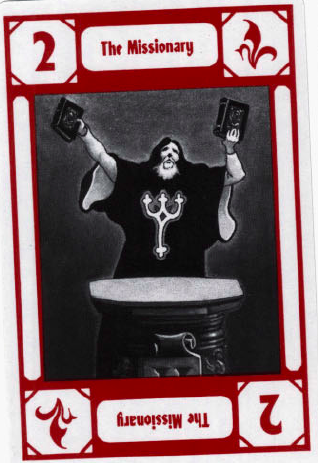
"The Abjurer's importance, four, is twice that of the Missionary, two. Together, they number six. We reveal a hexad."
"A triumvirate of evil has befallen the land. Vanquish them, and know peace.
Look within the Traitor to find the Beast.
Look within the Artifact to find the Anarchist.
Look within the Donjon to find the Necromancer.
[pause]
No - this is not correct..." [Kezia transposes The Traitor and The Beast]
"Along your journey hence, beware this card."
"But above all else, fear this."
Read Post
| 3
adventurers hailed
Labels: adnd, session recaps, tarokka
Friday, January 19, 2018
An example of player agency vs. DM narrative
I've self-debated these many times, and learned from past experience on several occasions. We discussed a hook where the PCs begin the campaign as captives in an arbitrary dungeon cell, without their equipment. Is this a reasonable thing to do to a party?
My answer is that most scenarios, including this one, are fine to incorporate into your game, if executed properly. Specifically, the DM should ensure that the party retains a meaningful degree of control over the session's outcome. The PCs should be participants and protagonists, not audience and onlookers to the DM's prologue. To elaborate, I described two ways that a DM might have the PCs-as-prisoners scenario play out.
In the first variation, the PCs awaken in a cell, clothed but lacking any weapons, armor, spellbooks, or equipment. They pass a day in confinement, devoid of opportunities to escape, but learning (from guards, other prisoners, etc.) of their surroundings, why they were captured, perhaps the identity of the mastermind who rules the dungeon: critical information that can be used later in the campaign. Shortly thereafter, a band of rescuers breaks into the cells, leads the PCs to their plundered wares, and shows them the way out. The party battles off a guard or two, but the instruction and heavy lifting are provided by the rescuers.
For the second variation, the PCs awaken in the same situation as the first. Early on, however, they're presented with a potential means of escape: a key slipped to them by a thief in an adjacent cell. The players deliberate on how to proceed; the more time that passes in the cell, the more information they garner from their surrounds. The session revolves around the party crafting and executing an escape plan, recovering their equipment, and making it out alive.
In variation #1, the DM likely ends up doing most of the talking throughout the session - mainly, telling the players what happens as the PCs tag along for the ride. In the second variation, however, the players control the pace, for their planning requires questioning the DM about the subtle details of the cell area, mannerisms of the guards, and demeanor of the other captives. They might spend time (even days) learning about the daily routines within the prison, when mealtimes and watch rotations occur, to figure out the optimal circumstances for breaking free. Do they try to get anyone else out with them? What about the thief who gave them the key?
At the end of variation #1, the players have bore witness to a grand escape, and feel relieved; at the end of variation #2, the players have orchestrated the escape itself, and feel accomplished.
In both variations, the DM starts with the same hook and progresses the campaign from the same point A to point B, but the player experience between the two varies greatly. As a player, I'd find myself disengaged at being an object of the DM's narrative in variation #1, whereas variation #2 would give me a sense of purpose from the beginning (despite the initial forced capture) and a substantial measure of fulfillment (not to mention camaraderie with the other players) upon executing a successful breakout. Variation #1 would leave me doubting whether I'd want to play in the DM's game again; variation #2 would leave me itching to find out what evil plans the party might foil next.
It all boils down to player agency, and enabling the players in your campaign to actually be players in your campaign, as opposed to merely observers. This is largely the stigma behind "railroading" in RPGs: it's not the presence of plot lines or story arcs that causes issues for most players, but the feeling that they, the players, were only invited to the table to consume the DM's narrative.
At the end of the day, AD&D characters are created to play the part of heroes. Let them.
Thursday, January 18, 2018
#3: The Prisoner
Read Post
| 2
adventurers hailed
Labels: journal, session recaps
Wednesday, January 10, 2018
Malaran rites
![]() |
| Carcerus, the "Black Devil" (Attribution) |
Zeb fully believes that he is the new cult's aclupar, and that Korvich will not rest until Zeb's blood is spilled before his former master in dramatic fashion. A trivial slaying will not suffice, and the presence of Carcerus amid the group is a fearsome indicator of the magnitude of the high priest's will.
#2: The Razing
Alerting Tussagar and Audric to the danger, we rush to the church, where we find Tyoness being held captive by Korvich, my mentor in the Beast Cults.
We follow cries back to the church, where we find Rould standing over the injured Tussugar, with Tyoness nearby, dead. The ashes of nearby buildings are cold, as if hours or even days have passed. Tussugar is rejuvenated, and we ponder the situation at hand.
Read Post
| 2
adventurers hailed
Labels: journal, session recaps
Monday, January 8, 2018
Session #1, Zeb's Notes
Read Post
| 3
adventurers hailed
Labels: journal
Sunday, December 31, 2017
Moonglow Cave: discoveries and dialogue
- It does seem possible that stirges (or similar creatures) could have killed the druid. Though the cave bears no immediate signs of being occupied, you find droppings similar to those of birds fairly littering the floor. Stirges (as Rould explains it) tend to move from place to place as food supplies are exhausted. Upon closer examination, Damyca's dead skin looks patchy and discolored - perhaps residual stains from bloodletting? If she was attacked in such a way, she was likely taken completely by surprise.
- It stands to reason, too, that the claw marks on the walls could have been made by the same "cave bear" that attacked the party in the forest, perhaps having been previously driven out by stirges, other enemies, or even Damyca(?). The "cats on furniture" hypothesis seems to fit the nature of the scratch marks.
- No other tracks are apparent, to Rould or anyone else. The area around the cave mouth is rocky and dry, ill-suited for leaving footprints and the like.
- The runes aren't so many, and Zeb can certainly begin scrawling them onto parchment, if he's willing to take some time before the party leaves.
- The dwarf has a stubborn air about him when questioned about the ring, but this seems more rooted in his own pride than a result of magical influence. He remembers not (or declines to say) the name of the man he acquired it from; the piece was unique, dwarvish in make, and he suspected (but had no way of proving) that it harbored some form of protective enchantment. In fact, he hadn't donned it at all until the morning of the group's departure. The ring was supposedly recovered amid a lot of plundered treasure from an abandoned mine.
- The trader was traveling with a larger mercantile company from Mirabar, which was following a similar route along the River Mirar, around midsummer. He remembers the group, given that few travelers pass through the village even during the height of trade season, but knows (or admits) little else.
- Damyca's body seems barren of anything useful. A nomadic druid, she carried a staff, a few basic provisions, and lacked anything magical (unless such valuables have already been plundered).
Read Post
| 1
adventurer hailed
Labels: adnd, fr, session recaps
Friday, December 29, 2017
#1: Shadfeld
Erathmar, a retired adventurer in search of rare ore from the nearby mountains, bade the PCs to take leave during their stay; soon after, their presence was sought by Shadfeld's high priestess who, along with a hunter named Rould, questioned the party's intentions and origin. The duo explained that a local druid had recently fled after imparting a premonition that great evil would descend upon the village. The druid, Damyca, served as a pillar of protection for the area, and her departure to seek meditation at a site known as Moonglow Cave spawned concern, both for her vision and in her failure to return after several days. Pledging their aid, Audric and Zeb offered to accompany Rould and Tussugar Grim, dwarf and village marchion, in search of the missing woman.
A day's travel took them deep into forested terrain, where they set a defensive camp in the bowels of a low valley. During the night, their alarms were triggered by an enormous bear that assaulted them from the darkness. Unable to run, they fought, Tussugar exchanging blows from the creature's paws with a gruesome cut from his rune-encrusted dwarven axe. Then, inexplicably, Tussugar dropped his weapon and convulsed, his stocky form melding into that of a bear, equal in size and strength to their aggressor. As the allies rained missiles upon the attacking bear, the transfigured Tussugar crushed its neck with his mighty jaw. The creature fell limp and Tussugar convulsed again, his body contorting back to that of a dwarf, ere he collapsed. The others, distraught, guarded the camp until sunrise.
Tussugar awoke to interrogation, and though he acknowledged what had transpired, he failed to explain his transformation, gruffly asserting that the company should continue on. After persisted questioning, however, the dwarf conceded possession of a pewter ring, purchased from an ore trader many weeks prior, which he suspected to be the source of the previous night's event. Using detect magic, Audric discerned an overwhelmingly powerful aura emanating from the artifact.
That eve, Moonglow Cave came within view, a rocky outcropping emanating a blue luminescence atop a small peak amid the forest. The company approached, discovering the blood-drained husk of Damyca inside its mouth. Too, they found claw marks from some massive creature and, in the cave's depths, undecipherable runes scribed in an unknown language.
DM's Commentary
Sean, Jason, and I have been playing at the idea for this campaign for a long time, so it's great to see it finally kicked off. Zeb and Audric are already deep characters, with aspects that extend well beyond anything written above. I think this session was a decent start, despite a bit of strangeness and quite a lot unanswered. Hopefully the player's agree!
It's Really Not Lord of the Rings
I don't love D&D games having a MacGuffin; I realize that the plundered scepter felt like one during the last campaign, and that the sudden appearance of a transcendent ring ushers in similar vibes here as well. I don't stage the exact way sessions will unfold (even first sessions!), and there were elements of chance involved that I can't elaborate on presently, but that definitely contributed to much of what transpired in-game. You guys may just have to take me at my word, for now...
Read Post
| 7
adventurers hailed
Labels: adnd, fr, session recaps
Tuesday, December 26, 2017
New campaign prep
Read Post
| 0
adventurers hailed
Labels: adnd
Wednesday, December 6, 2017
Company Charter
The charter need not be set in stone. One of the great things about roleplaying games is that characters develop and change over time, and so to should our charter change to suit great events that befall us or changes in outlook or perception.
One underlying theme, at least in some of the characters currently being developed, is magic or the pursuit of magic. As such, I put forth the following suggestion for our company charter, at least at the beginning.
- Magic and the produce of magic, be it spells or items or creatures, are beyond the comprehension of most common folk. As adventurers possessed of unique abilities, we are responsible for protecting the common folk from magic that would do them harm.
- Magic is ancient, and current civilization is built upon the ruins of great magical cultures. Relics of these cultures sometimes surface, and it is of great interest to us to pursue and secure the safety of these items, lest they fall into the wrong hands.
- Magic is a powerful and sometimes unpredictable force; when magical mysteries manifest, we are responsible for discovering the source of these mysteries, and to control them when necessary lest they bring harm to others.
- Not all magic is benevolent; magic whose sole purpose is to harm should be pursued, controlled, and when possible destroyed.
Tuesday, December 5, 2017
The Crusader (creating a new character class)
Crusader (work in progress)
- Must be human (modifier: 0)
- Priest combat values (0)
- Priest saving throw table (0)
- d8 hit dice (+1)
- All armor allowed (0)
- All weapons allowed (0)
- +2 hp per level beyond 9th (+1)
- Cast three spheres of priest spells (+6)
- Learn and cast one school of magic (+3)
- No ability to turn undead (0)
- Use magical items allowed to priests (+1)
- Must be good-aligned (-1)
- Has particular ethos that must be obeyed (-1)
- Cannot keep more treasure than can carry (-0.5)
- Cannot own more than 10 magical items (-0.5)
| Level | Crusader | Mage | Cleric |
| 1 | 0 | 0 | 0 |
| 2 | 1,800 | 2,500 | 1,500 |
| 3 | 3,600 | 5,000 | 3,000 |
| 4 | 7,200 | 10,000 | 6,000 |
| 5 | 18,000 | 20,000 | 13,000 |
| 6 | 36,000 | 40,000 | 27,500 |
| 7 | 72,000 | 60,000 | 55,000 |
| 8 | 135,000 | 90,000 | 110,000 |
| 9 | 252,000 | 135,000 | 225,500 |
One major facet of the class that we need to figure out is how wizard spellcasting should be implemented. The reason for the ability to cast a single school of wizard spells (Sean is choosing conjuration/summoning) is the character's devout ties to Mystra. As such, I think there are two main approaches to consider:
- The crusader casts priest spells as a priest and wizard spells as a wizard. That is, the crusader's priest and wizard spell slots are independent (the character effectively gets both); bonus spells apply only to the priest spell slots; wizard spells must be learned through study as opposed to prayer; and armor cannot be worn when casting wizard spells (same as a wizard or bard). This treats the character as a multi-classed cleric/mage in terms of spellcasting.
- The crusader casts all spells as a priest. That is, all spells are gained through prayer, using the character's single set of priest spell slots; the wizard spell school is treated as just another priest sphere; no spellbook is needed and no armor restrictions are applied.
Creating a new class isn't something I've dabbled in before, and it's important that the end result is reasonably fair and balanced (at least, as balanced as anything in AD&D). Interested to hear anyone else's take; the class as constructed seems relatively strong and versatile at low levels, but suffers from a slower rate of advancement the longer the campaign goes on.
Sunday, December 3, 2017
Party creation recap and next steps
- The selected classes are transmuter, ranger, cleric/abjurer (dual-classed), and "crusader" (2e fighter/cleric kit, pending final approval)
- It appears that all PCs will likely be human
- The party has agreed on a good-aligned moral compass, rejecting thievery but with a possible anti-establishment penchant (e.g., Robin Hood analogy); the overall party alignment looks to be "neutral good"
- All ability score rolls are completed
- Starting XP will be 5,000 per character (prime requisite bonuses apply)
- Max hit points are assumed for 1st level; all other levels should be rolled; all 1's may be re-rolled
If more detailed information than this is needed, it may be best to pose specific questions or pitch me your background ideas for me to help work them in. Backgrounds are not of the greatest importance in the big scheme of things.
All for now!
Monday, November 6, 2017
The Quick Primer: remembering what you know
Not sure if all the players have read this before; if so, it may have been a while for them, too. The PDF isn't long and though I recommend reading it in its entirety, Zen Moments #2 and #4 (along with some of the "Tips for Players") stood out to me as particularly relevant to many of the sessions we played, including the last.
For my part, it's tough not to fall into the trap of issuing repetitive "miss/miss/hit/miss" responses to attack rolls in combat. Sometimes, when there's a lot going on, you need to devolve to the most basic descriptions to keep things moving. But, even then, spicing up the combat scene here and there is critical not only in providing flavor and excitement for the participants, but also in reminding them that their options are infinitesimally more varied than swinging a morningstar or firing a bow.
Read Post
| 0
adventurers hailed
Labels: adnd, quick primer
Sunday, November 5, 2017
FR #17: Beyond Death's Door
4 Flamerule
Having arrived in Mirabar under cover of darkness with Aranos still incapacitated, the party sought refuge at an inn whose placard had long since faded. The next day, while Aranos rested and Riwyn tended her scrolls, Wren and Arendeth made contact with a lanky, buoyant man named Drunfeldt, who bid the party to sup with him that eve at a nearby residence where they might find suitable employment.
They agreed, and subsequently visited the cottage of Agloroth and Reticence, a husband-and-wife duo nearing sixty winters who brokered specialist work for the city. The couple explained that, in early spring, rich veins of silver were struck in a previously unworked area of the lower peaks of the Spine of the World. Regrettably, the mine bearing the silver collapsed, killing a score of men and dwarves, the tunnel rendered completely impassable.
More recently, additional teams dispatched to the area located a second cave, harboring a catacomb which led toward the vicinity where the silver was found. Thirteen miners delved deeply within, but only three returned. Of these three, all were seriously injured, one having already died, the others left in the care of a cleric of Moradin in the Undercity. The survivors bore accounts of miners ripped limb-from-limb by a massive creature that neither could identify. Prior to this, the miners had been set upon by chitines: ruthless, four-armed humanoids with an affinity for traps and deception. While the miners stayed off the chitines to some success, the emergence of the larger enemy brought about their doom. Moreover, the miners spoke of other oddities in the tunnel that impeded them in battle: a solid stone wall that softened into mud, and errant, spell-like effects.
In light of these events, further exploration of the area was abandoned until a properly-equipped band could ensure the safety of future expeditions. Agloroth and Reticence offered a bounty of 5,000 gold pieces for proof that any threats to miners had been eliminated.
The PCs accepted the job, passed a day making preparations and locating one of the survivors in the Undercity, and departed north, with Drunfeldt escorting them to the base of the lower peaks. A family of perytons, airborne predators with the bodies of eagles and the antlered heads of stags, had recently been sighted near their destination, and as such the party traveled at night to avoid the creatures' daytime activity cycle.
At the landmark denoting the farthest reach of Mirabar's protection, Drunfeldt rode back for the city, and the party made camp under tree cover at dawn, spotting the perytons during their watches but avoiding any unwanted attention. When darkness again came, they trekked to the plateau that harbored the cave entrance, looking down upon a valley to the north where a spattering of fires suggested an encampment of unknown inhabitants, more than a mile off.
Deciding against an investigation, they entered the cave as the sun began to rise. Inside, the air was cool and damp, and they penetrated the tunnel with caution, prodding at the natural stone floor, wary of ambushes or traps.
As they descended, they found signs of the miners' deliverance: drained and consumed corpses, and a severed dwarf arm which bore a gleaming, pewter ring on one of its fingers. Leaving it, they advanced to an area of the tunnel where thick strands of webbing blocked a portion of the way forward, leading passers-by toward a deep hole burrowed into a section of softened stone. The party burned away the webs and circumvented the hazard, then came upon an impossibly thick barricade of webs, which they similarly vanquished.
Uncertain from the lack of a clear threat, they continued on, setting a makeshift camp near the edge of a partially-webbed segment of tunnel, and passing a few restless hours before a skittering noise betrayed a fleeting, shadowy form ascending the wall, amid the strands.
Concerned, they drew weapons and advanced, cutting at the webs ere being descended upon by several four-armed creatures who assaulted them viciously with claws and blades. Only Riwyn drew back, the others wading into combat, outnumbered and suffering from the chitines' multitude of attacks. Upon casting glitterdust and exposing a dozen more creatures lurking near the ceiling, Riwyn attempted to invoke a powerful spell from one of the scrolls plundered underneath Brithem, but failed.
The spell, chain lightning, had a failure chance of 45% due to being nine caster levels higher than Riwyn could normally use. This was an epic roll, as it almost certainly would have saved the party from its recklessness and felled the chitines, to the one, had it worked.Aranos succumbed to his many wounds, and Arendeth was set upon in full as the glitterdust faded, vying to utter hold person against the four chitines that surrounded him.
This chance, too, failed by a hair. Sean executed his spell, rolling a "4" for the number of enemies affected, on the same initiative count that Arendeth was assailed, before realizing that he'd misstated the spell's casting time. The chitines' attacks subsequently disrupted his casting, thwarting the spell.Wren and Arendeth were laid low. Riwyn, still uninjured, bolted from the melee, but the chitines doubled the elf's speed. Lighting a torch amid the cavern, she struck and killed one of the vile creatures before they took her life.
The party fell on the eighth day of Flamerule, Year of the Bow (1354 DR). Their story, for now, is at its end.
Post-mortem
AD&D is a difficult game. This is easy to forget when surviving, time and again, whether by luck of the dice, sound strategy, or favorable circumstance. Laughing and joking around the table, it often feels like participation is enough, that the greatest challenge is in making the time in our busy schedules to get together to keep the game going. That a high-level character is the eventual reward for a steady dose of regular attendance over time.
Not so. A high-level AD&D character is truly something to be treasured, the culmination of years of emotional investment and consistent execution. Creating a high-level PC from scratch is one of the least fulfilling RPG experiences I've known, which is why I enforce that any new PC joining an existing game, for any reason, must start at the initial XP total set for all characters when the campaign begins. If this results in a 1st-level mage signing on with a party of established, 9th-level adventurers, so be it. The mage will make his place soon enough, or die trying. From the starting point onward, every new level and ability must be earned.
Last night, there was no lone decision that cost the PCs their lives. There were avenues of escape, dice that might have fallen the other way, and choices to be looked back upon and questioned. We talked about how the party could have sought hirelings in Mirabar, could have proceeded differently in the tunnel, could have managed the combat with the chitines more judiciously. I need not rehash it all here. This session was a grim reminder of the dangers of adventuring, and hopefully comes with lessons to be remembered during the players' next AD&D foray.
What Next?
I have no specific plans yet for how to move forward from here. We've breathed life into this setting through our play, and that could be something I choose to leverage in developing a new campaign. A higher-level party may have possessed retainers, heirs, or next of kin to take over the reins as new PCs, but this group is effectively ended with the deaths of Arendeth, Aranos, Riwyn, and Wren. Might a new party emerge somewhere nearby and experience the world anew? There's much to be considered and discussed in the coming days, balancing the availability, schedules, and interest levels of everyone involved.
Final XP Totals
No experience is gained from a session in which every character dies. Berwyn and Lincoln were not present and technically are still alive. For archive purposes, here are the sidebar XP totals as they stand today:
- Berwyn - 11,169
- Arendeth - 15,472
- Riwyn - 7,736/7,736
- Wren - 7,033/7,736
- Lincoln - 10,852
- Aranos (h) - 2,128
Read Post
| 0
adventurers hailed
Labels: adnd, fr, session recaps, tpk, xp
Tuesday, July 11, 2017
Mounted Combat
Mounts trained for combat (a heavy warhorse, for example) present few problems. These can be used in mounted combat with no penalties. However, steeds not trained for combat are easily frightened by the noise and confusion.The horses purchased in Luskan are riding horses only, so going forward this -2 penalty will apply. With regards to melee combat:
Those fighting from the back of untrained creatures suffer a -2 on their chance to hit, since much of their time is spent simply trying to keep the mount under control.
In mounted fighting, a character gets a +1 bonus to his chance to hit creatures smaller than his mount. Thus, a man on horseback gains a +1 bonus to his attack rolls against all medium-sized creatures such as other men, but would not gain this bonus against another rider or a giant. Those on foot who fight against a mounted rider, have a -1 penalty; this not applied to attacks against the mount, however.This would have reduced the first penalty to -1, since the wargs were medium-sized creatures. The wargs wouldn't have incurred a penalty, since they were attacking mounts or dismounted PCs. Missile combat, understandably, is more difficult:
Missile fire from the back of a moving horse is possible only if the rider is proficient in horsemanship. Even then, only short bows, composite short bows, and light crossbows can be fired from horseback by normally proficient characters.There are details beyond this, including penalties if trying to fire while the mount is moving, but let's leave it here until that situation arises. We don't use proficiencies, but I'll allow short bows and light crossbows to be fired by PCs succeeding a Dexterity check, with failure meaning that the round is lost trying to control the mount (with no ammunition expended). Spellcasting can work similarly. Fair?
Long bows can be used by those with specialization (if this is used). Heavy crossbows can be fired once, but cannot be reloaded by a mounted man since the bracing and pull is inadequate.
I also was too liberal in causing characters to fall from their horses in combat, some of which I corrected during the session. Even Aranos' fall, however, shouldn't have happened, by the book. Here are the relevant excerpts:
Killing the Mount: This is the grim and efficient method. Once the horse (often an easier target) is dead, the rider is certainly dismounted. The steed automatically falls to the ground.Again in the absence of proficiencies, a Dexterity check should suffice to avoid taking damage from a fall. Aside from killing the steed, an attack roll of 20 will dismount a rider, but a "normal" hit against either party will not:
If the rider has the Riding proficiency, he can attempt to land safely on his feet on a successful check. Otherwise, the character also falls to the ground and suffers 1d3 points of damage. The character cannot take any action that round and must spend another entire round gathering himself back up and getting to his feet.
Weapon Impact: Riders also can be knocked off by solid blows from a variety of weapons. Any time a rider hits another mounted character or creature with a melee weapon 3' or longer and scores a natural 20 on the roll, the other character is knocked from the saddle, suffering 1d3 points of damage (if from the back of a normal horse).There's a lot here to digest, and more in the actual rulebook. I turned out to be a bit harsh in my rulings, but should be better equipped to deal with this next time.
Read Post
| 0
adventurers hailed
Labels: 2e, adnd, mounted combat, rules
FR #16: The Road to Mirabar
Recovery from the catacomb was long and arduous, absent Arendeth's magical healing for several days while the dwarf regained his strength. Though the fallen were tended to graciously, the party was otherwise left to deliberate its course, and the decision made was for Luskan. Before their departure, the PCs were solicited by the missionaries, Lucido and Winifred, that adventuring work in the name of Tyr could be found under the employ of their benefactor, Elidar Highborn, in Leolin. The offer was considered, but declined.
They reached Luskan two days hence, having encountered a trio of armored riders and a small contingent of wagoners en route. As the sunlight faded over the Sea of Swords, Luskan's gate-guards demanded a steep tariff for entry, taking advantage of the late hour and of the city's inherent prejudice toward non-humans. With a sour taste for the place already, the party made its way to the piers and procured lodging at the Shadowatch Inn.
Inside, they were met by an old acquaintance, Pevrel the gnome, who admitted to following the PCs since their episode at the gate. The gnome, who concealed a trained ferret underneath his tunic, mentioned that a local ranger was seeking arms-for-hire to combat goblin uprisings to the east, in addition to hearsay that an unnamed man was bartering in high coin with magistrates of Luskan's "prisoners' carnival" for its captives, effectively thwarting a number of (gruesome) public executions.
The gnome left after drinking his fill, and the next morning the PCs visited a moneychanger to unburden themselves of the copper, silver, and electrum plundered from the catacomb. While Arendeth and Aranos tended the coins, Wren and Riwyn were quietly approached by a hooded man in the marketplace in search of crew for a southbound merchant caravel; at an offer of a hundred gold pieces per head but requiring immediate service, Wren displayed interest but neglected to commit. Upon reuniting, the party agreed to move on from the likes of Luskan and spent the remainder of the day purchasing and outfitting riding horses before departing the city's north gate with an eye for Mirabar.
The lightly-beaten road rolled over vast stretches of hills and plains, the River Mirar flowing ever at the edge of their view to the south. For three days they traveled without incident, but that eve the tranquility was broken by the howling of wolves, far in the distance. On the fourth night, after Arendeth scribed a protective glyph of warding around those who slept, the howls were usurped by a crescendo of marching, singing, and rolling wagon wheels as a caravan crested loudly toward the party. Its lead rider drew close, hailing the PCs and imparting that a pack of dire wargs lurked dangerously near - enough so that the caravan, a camaraderie of men and dwarves journeying from Mirabar to Luskan, broke camp in the dead of night to distance themselves from the threat.
Denying an offer to return with the company to Luskan, the party continued watches into the early morn, finally being set upon by a pair of the fell creatures as they rode on. Aranos was bucked from his horse and mauled to unconsciousness before the wargs were slain, ere the party pressed on wearily, arriving at Mirabar's gates after middark on Flamerule the Fourth.
DM's Commentary
Overland travel is no picnic, and the PCs are lucky to have completed a 240-mile journey with no unrecoverable losses. Merchants caravan in large numbers for a reason, and while adventurers oft possess skills and defenses that commoners do not, a full pack of wargs had a sizable chance of annihilating the party outright; as it was, though they ventured on in spite of warnings from the company from Mirabar, fortune saw them meet only two of the creatures along the road. Had they been set upon at night, when the entirety of the pack was afoot, the outcome may have proved disastrous (although Arendeth's glyph of warding was a superb proactive measure, to be sure).
Luskan and Brithem feel far removed as the salty breezes from the Sea of Swords have given way to rolling pastures and silhouettes of mountain peaks on the northern horizon. For now, marshes and catacombs, gnolls, gate-guards, and banditry seem little more than distant memories.
(My initial draft included a section here for mounted combat, but it ended up being long enough that I'm making it a separate post for easier future reference.)
Riding Horse Attributes
It bears mentioning the attributes of the riding horses procured in Brithem, whether or not they're needed again soon:
- Hit dice: 3 (i.e., 3d8 hit points each, rolled randomly)
- Hit points: 17 (Riwyn's mount), 12 (Wren's mount), 17 (Arendeth's mount), 9 (Aranos' mount)
- Armor class: 7
- Movement: 24 (240 yards)
- THAC0: 17
- # of attacks: 2 (per round)
- Damage/attack: 1d2/1d2
Since the party has landed at a (presumed) safe point, I do want to award XP for the wargs, even though the amount is small enough to warrant rounding up to simplify my math (we'll call the total 100 XP per PC and 50 XP for Aranos).
I've discussed at various points previously (most recently here) the Tao of D&D XP system, which awards experience primarily based on damage dealt to and by combatants and spellcasters. I still don't feel that the entirety of this system is appropriate for our game, however I am going to begin issuing individual awards of 20 XP per point of damage sustained by PCs and henchmen, effective this session. In short, this helps bolster the party's XP in a fair and realistic way, while not significantly affecting my bookkeeping. I may continue to refine the XP system later on, but for now I see this as a "quick win."
As a result, Aranos (the only combatant damaged against the wargs after I retracted falling damage from Riwyn and Wren) sustained a total of 15 points, and therefore receives an additional award of 300 XP for the session. Accounting for this and for prime requisite bonuses, the party totals now stand as:
- Arendeth - 15,472
- Riwyn - 7,736/7,736
- Wren - 7,033/7,736
- Aranos - 2,128
Read Post
| 0
adventurers hailed
Labels: adnd, fr, session recaps, xp