Thursday, February 22, 2018
Sunday, February 18, 2018
Class distributions, part 3 (modeling a society)
Scribe:
Matt S
Part 1
Part 2
From the 2e DMG, p. 17:
Let's go back to the original "fall through" algorithm that classifies everyone either as having a single class or being non-classed. When we ran the numbers previously, we said that any qualifying person was assigned to a class; the only individuals not assigned a class were those who didn't qualify.
Ultimately, that's not realistic. There should be factors other than ability scores at play in an actual society: age, alignment and training considerations, desire, upbringing, and so forth.
We determined, rolling 3d6 in order, that slightly more than one in every thousand individuals would qualify to be a paladin, based on ability scores alone. But consider what else is required: the person would need to be of sufficient age, of proper alignment and disposition, willing to adhere to the strictness of the paladin's code, and raised under conditions that would allow for the training needed to ascend the ranks of the class. What percent of those meeting the paladin's ability score requirements would also conform to the above? Ten percent? Five percent? Less?
Let's suppose, very generously, that for any individual meeting the ability requirements for a particular class, there's only a 50% chance of the class actually being attained. I can adjust the algorithm to work as it did previously, but to reject half the sets of scores that qualify for each class. In other words, half of those who would otherwise meet the paladin requirements fall through and check for the "easier" classes instead. Some will end up being bards, druids, or fighters. Others will end up having no class at all.
I don't have a perfect way to arrive at these values, so to start, I'm just going to make them up:
Here are the results for populations of 100 and 20,000:
I hope this series of posts was interesting for anyone who ends up reading. I certainly think it's something I may use in my games going forward.
Part 2
From the 2e DMG, p. 17:
Only a few people actually attain any character level. Not every soldier who fights in a war becomes a fighter. Not every urchin who steals an apple from the marketplace becomes a thief. The characters with classes and levels have them because they are in some way special.It's common sense, and there are numerous passages to support, that only a fraction of people in an AD&D society are classified as adventurers. Most are normal folk, perhaps trained in some vocation, with some of them being stronger, hardier, or more intelligent than even many PCs. What if we wanted to find out, given a population, how many of each class should really be present?
Let's go back to the original "fall through" algorithm that classifies everyone either as having a single class or being non-classed. When we ran the numbers previously, we said that any qualifying person was assigned to a class; the only individuals not assigned a class were those who didn't qualify.
Ultimately, that's not realistic. There should be factors other than ability scores at play in an actual society: age, alignment and training considerations, desire, upbringing, and so forth.
We determined, rolling 3d6 in order, that slightly more than one in every thousand individuals would qualify to be a paladin, based on ability scores alone. But consider what else is required: the person would need to be of sufficient age, of proper alignment and disposition, willing to adhere to the strictness of the paladin's code, and raised under conditions that would allow for the training needed to ascend the ranks of the class. What percent of those meeting the paladin's ability score requirements would also conform to the above? Ten percent? Five percent? Less?
Let's suppose, very generously, that for any individual meeting the ability requirements for a particular class, there's only a 50% chance of the class actually being attained. I can adjust the algorithm to work as it did previously, but to reject half the sets of scores that qualify for each class. In other words, half of those who would otherwise meet the paladin requirements fall through and check for the "easier" classes instead. Some will end up being bards, druids, or fighters. Others will end up having no class at all.
*** Rolling method: 3d6 (in order) ***As we still have far more "classed" individuals than non-classed, the 50% reject rate is not nearly enough. And perhaps some classes should have lower percentages than others? The paladin's non-ability requirements are such that members of this class should be rare indeed. Rangers, bards, and druids all have alignment (and to some extent environmental) restrictions. Fighters should be more common, requiring only martial training and permitted to be any alignment. Thieves can't be lawful good, and lock-picking can't be learned on a whim. Clerics and mages require access to religion and magic.
*** Population: 100
Results...
Pal: 0 (0%)
Rgr: 0 (0%)
Brd: 0 (0%)
Drd: 0 (0%)
Ftr: 39 (39%)
Thf: 26 (26%)
Clr: 14 (14%)
Mge: 12 (12%)
Nil: 9 (9%)
******************
*** Population: 20000
Results...
Pal: 15 (0%)
Rgr: 20 (0%)
Brd: 107 (1%)
Drd: 322 (2%)
Ftr: 7254 (36%)
Thf: 4457 (22%)
Clr: 2845 (14%)
Mge: 1827 (9%)
Nil: 3153 (16%)
******************
I don't have a perfect way to arrive at these values, so to start, I'm just going to make them up:
- Paladin - 5%
- Ranger - 10%
- Bard - 10%
- Druid- 10%
- Fighter - 20%
- Thief - 15%
- Cleric - 10%
- Mage - 10%
Here are the results for populations of 100 and 20,000:
*** Rolling method: 3d6 (in order) ***These numbers look OK at the top, but the core classes feel too highly represented. 36% of a population isn't going to have class levels. The problem may be that very few individuals can qualify for a class like paladin or ranger to begin with, so it stands to reason that a larger cut of these prodigies will end up rising to their potential, despite the narrower requirements. I'll leave the numbers for the "hard" classes unchanged but reduce the core classes to:
*** Population: 100
Results...
Pal: 0 (0%)
Rgr: 0 (0%)
Brd: 0 (0%)
Drd: 1 (1%)
Ftr: 17 (17%)
Thf: 11 (11%)
Clr: 7 (7%)
Mge: 4 (4%)
Nil: 60 (60%)
******************
*** Population: 20000
Results...
Pal: 2 (0%)
Rgr: 4 (0%)
Brd: 15 (0%)
Drd: 58 (0%)
Ftr: 2892 (14%)
Thf: 1945 (10%)
Clr: 1105 (6%)
Mge: 1087 (5%)
Nil: 12892 (64%)
******************
- Fighter - 3%
- Thief - 2%
- Cleric - 1%
- Mage - 1%
Results:
*** Rolling method: 3d6 (in order) ***This looks a lot better. Only one in twenty receives a character class, with a single party worth of adventurers servicing a small hamlet. The prevalence of spellcasters still feels high, but these numbers are usable for modeling a population in a campaign. I don't want to worry about fractional percentages at this point.
*** Population: 100
Results...
Pal: 0 (0%)
Rgr: 0 (0%)
Brd: 1 (1%)
Drd: 0 (0%)
Ftr: 1 (1%)
Thf: 1 (1%)
Clr: 1 (1%)
Mge: 1 (1%)
Nil: 95 (95%)
******************
*** Population: 20000
Results...
Pal: 1 (0%)
Rgr: 5 (0%)
Brd: 18 (0%)
Drd: 67 (0%)
Ftr: 447 (2%)
Thf: 296 (1%)
Clr: 143 (1%)
Mge: 137 (1%)
Nil: 18886 (94%)
******************
I hope this series of posts was interesting for anyone who ends up reading. I certainly think it's something I may use in my games going forward.
Saturday, February 17, 2018
More on class ability score requirements
Scribe:
Matt S
Building off the previous post, let's look at the numbers from a different angle. The algorithm I created was designed to simulate the class eligibility of an actual D&D population. If the results given by the model feel too generous, you can divide by a factor that represents the percentage of inhabitants that even get a crack at having ability scores assigned. This could account for age distribution across the populace and enforce the notion that only a subset of people are worthy of becoming adventurers. Even at less than 1% of total, 26 individuals with paladin-eligible ability scores in a city of 20,000 may feel like too many.
Another thing to be mindful of is that, based on the algorithm, all thieves have strength of 8 or lower, all clerics have strength and dexterity of 8 or lower, and all mages have 8 or lower in strength, dexterity, and wisdom. This is flawed, so while the algorithm can be used to derive the distribution of classes within a population, it shouldn't be used to make assumptions about the ability scores of any one individual.
Turning the page, what if the DM is less interested in simulating a population and more interested in knowing the odds of meeting class requirements using a specific rolling method? The code can be changed a little to generate these numbers. Here's a sampling of 100 individuals across the same two rolling methods. Instead of stopping when a set of scores meets the requirements for a class, we continue checking to figure out all character classes for which the scores are eligible.
*** Rolling method: 3d6 (in order) ***
*** Population: 100
Results...
Pal: 0 (0%)
Rgr: 0 (0%)
Brd: 0 (0%)
Drd: 2 (2%)
Ftr: 71 (71%)
Thf: 67 (67%)
Clr: 71 (71%)
Mge: 82 (82%)
Nil: 100 (100%)
******************
*** Rolling method: 4d6 drop lowest (in order) ***
*** Population: 100
Results...
Pal: 0 (0%)
Rgr: 7 (7%)
Brd: 4 (4%)
Drd: 4 (4%)
Ftr: 89 (89%)
Thf: 85 (85%)
Clr: 85 (85%)
Mge: 90 (90%)
Nil: 100 (100%)
Here are the results against a population size of 20,000:
*** Rolling method: 3d6 (in order) ***
*** Population: 20000
Results...
Pal: 26 (0%)
Rgr: 28 (0%)
Brd: 183 (1%)
Drd: 658 (3%)
Ftr: 14884 (74%)
Thf: 14815 (74%)
Clr: 14751 (74%)
Mge: 14811 (74%)
Nil: 20000 (100%)
******************
*** Rolling method: 4d6 drop lowest (in order) ***
*** Population: 20000
Results...
Pal: 314 (2%)
Rgr: 608 (3%)
Brd: 1451 (7%)
Drd: 2896 (14%)
Ftr: 17935 (90%)
Thf: 18040 (90%)
Clr: 17884 (89%)
Mge: 17911 (90%)
Nil: 20000 (100%)
******************
This gets us closer to the "truth"; look at how the percentages for the four core classes (which all have statistically the same requirements) begin to normalize.
Now let's change the algorithm further to arrange each set of scores optimally. It actually gets a lot easier to be a paladin when the 17 doesn't need to fall in a specific slot. Ranger proves the most difficult class when rolling 3d6 but allowing the scores to be rearranged. 4d6, however, makes the ranger's 13s and 14s easier to hit, so paladin again becomes the hardest.
*** Rolling method: 3d6 (arranged to taste) ***
*** Population: 20000
Results...
Pal: 1127 (6%)
Rgr: 718 (4%)
Brd: 4535 (23%)
Drd: 7811 (39%)
Ftr: 19997 (100%)
Thf: 19997 (100%)
Clr: 19997 (100%)
Mge: 19997 (100%)
Nil: 20000 (100%)
******************
*** Rolling method: 4d6 drop lowest (arranged to taste) ***
*** Population: 20000
Results...
Pal: 5476 (27%)
Rgr: 6108 (31%)
Brd: 13734 (69%)
Drd: 15592 (78%)
Ftr: 20000 (100%)
Thf: 20000 (100%)
Clr: 20000 (100%)
Mge: 20000 (100%)
Nil: 20000 (100%)
Using the 3d6 method, only three sets out of 20,000 failed to get even a single 9. No set failed to get at least one 9 using the 4d6 method.
Lastly, here's the same experiment with the population upped to one million:
*** Rolling method: 3d6 (arranged to taste) ***
*** Population: 1000000
Results...
Pal: 57141 (6%)
Rgr: 36272 (4%)
Brd: 227410 (23%)
Drd: 387935 (39%)
Ftr: 999699 (100%)
Thf: 999699 (100%)
Clr: 999699 (100%)
Mge: 999699 (100%)
Nil: 1000000 (100%)
******************
*** Rolling method: 4d6 drop lowest (arranged to taste) ***
*** Population: 1000000
Results...
Pal: 270407 (27%)
Rgr: 305016 (31%)
Brd: 689606 (69%)
Drd: 782784 (78%)
Ftr: 999998 (100%)
Thf: 999998 (100%)
Clr: 999998 (100%)
Mge: 999998 (100%)
Nil: 1000000 (100%)
******************
The percentages are basically unchanged, though two unlucky players failed to qualify for any class by rolling 4d6.
While this data does little to simulate a population, it might be a great tool for DMs who want to influence the likelihood of players achieving certain class requirements by choosing a specific rolling method.
Friday, February 16, 2018
Class distribution over population size
Scribe:
Matt S
This is an experiment I've wanted to try for a little while now. In an actual settlement populated by individuals having ability scores generated by the classic "3d6 in order" rolling method, how many would qualify for the various classes?
To obtain some data, I wrote a simple program that rolls sets of ability scores X number of times, based on the desired population size. Each "person" is evaluated based on the minimum ability requirements for the standard AD&D classes and assigned to the "best" class for which the individual qualifies.
In this context, "best" can be interpreted as "hardest," or most stringent ability requirements. The algorithm I implemented is a "fall through," such that each set of scores is "tested" for the most difficult class (paladin) first. If the scores fail to meet the requirements, they get tested for the next most difficult class (ranger), and so on.
When we get down to the four basic classes, which each require a 9 in the prime requisite and nothing else, they're ordered like this:
Here are the results for a hamlet with a population of 100:
Of course, in a "real" AD&D village, most of the population would be non-classed (i.e., 0-level villagers). So it's important to read these numbers as representing the top end of the population's potential, rather than an actual class distribution. Most of the "fighters" are likely to be simple common folk with a strength score of 9 or higher. There's also the fact that the population would be spread across different age groups: a five-year-old with a 17 charisma isn't going to be a paladin (at least, not yet).
Here's another hamlet:
Let's take a look at a small town of 500 residents:
One thing I wondered before doing this was, which class requirements between paladin and ranger are more difficult to meet? Paladins definitely feel like they should be rarer; since both classes have stringent yet different requirements, what happens when we roll the 20,000-person city but allow individuals that qualify for both classes to be rangers instead of paladins?
I'll go back to giving paladins the benefit of the overlap. Now let's adjust the rolling method. Here are two hamlets, the first using "3d6 in order," the second using "4d6 drop lowest" (but still in order):
Finally, let's blow this up to a 20,000-person sampling:
Keep in mind that the 4d6 method employed by most DMs allows the player to rearrange the ability scores, making any class much easier to qualify for compared to keeping the rolls in order. I'm sure there are more experiments I can run with this code, but I'll cut it off here for now. Interested to hear any thoughts or ideas.
To obtain some data, I wrote a simple program that rolls sets of ability scores X number of times, based on the desired population size. Each "person" is evaluated based on the minimum ability requirements for the standard AD&D classes and assigned to the "best" class for which the individual qualifies.
In this context, "best" can be interpreted as "hardest," or most stringent ability requirements. The algorithm I implemented is a "fall through," such that each set of scores is "tested" for the most difficult class (paladin) first. If the scores fail to meet the requirements, they get tested for the next most difficult class (ranger), and so on.
When we get down to the four basic classes, which each require a 9 in the prime requisite and nothing else, they're ordered like this:
- Fighter
- Thief
- Cleric
- Mage
Here are the results for a hamlet with a population of 100:
*** Population: 100No paladins, rangers, or bards. Two mages, three clerics, nineteen thieves, and 73 fighters. "Nil" is for scores that qualify for no class at all (ouch).
Results...
Pal: 0 (0%)
Rgr: 0 (0%)
Brd: 0 (0%)
Drd: 3 (3%)
Ftr: 73 (73%)
Thf: 19 (19%)
Clr: 3 (3%)
Mge: 2 (2%)
Nil: 0 (0%)
Of course, in a "real" AD&D village, most of the population would be non-classed (i.e., 0-level villagers). So it's important to read these numbers as representing the top end of the population's potential, rather than an actual class distribution. Most of the "fighters" are likely to be simple common folk with a strength score of 9 or higher. There's also the fact that the population would be spread across different age groups: a five-year-old with a 17 charisma isn't going to be a paladin (at least, not yet).
Here's another hamlet:
*** Population: 100Similar distribution, but this village could have a paladin, a ranger, and a bard among its inhabitants. Of note, I think druid, of all the classes, feels "easier" to qualify for than it should. In terms of realism, druid should have a similar rarity to the three classes above it. The bard's requirements are clearly much harder to meet, even though both include a 15 charisma. Remember that only those that make druids but also fail to make bards are assigned to be druids.
Results...
Pal: 1 (1%)
Rgr: 1 (1%)
Brd: 1 (1%)
Drd: 4 (4%)
Ftr: 72 (72%)
Thf: 15 (15%)
Clr: 3 (3%)
Mge: 2 (2%)
Nil: 1 (1%)
Let's take a look at a small town of 500 residents:
*** Population: 500The percentages begin to normalize with a higher population size. (Also, the previous hamlet was fairly lucky to have both a ranger and a paladin.) Here's a city of 20,000:
Results...
Pal: 1 (0%)
Rgr: 0 (0%)
Brd: 6 (1%)
Drd: 13 (3%)
Ftr: 354 (71%)
Thf: 104 (21%)
Clr: 15 (3%)
Mge: 6 (1%)
Nil: 1 (0%)
*** Population: 20000Now the "true" percentages become clearer still. At this sample size we greatly reduce the chance of outliers.
Results...
Pal: 25 (0%)
Rgr: 31 (0%)
Brd: 166 (1%)
Drd: 625 (3%)
Ftr: 14197 (71%)
Thf: 3606 (18%)
Clr: 969 (5%)
Mge: 272 (1%)
Nil: 109 (1%)
One thing I wondered before doing this was, which class requirements between paladin and ranger are more difficult to meet? Paladins definitely feel like they should be rarer; since both classes have stringent yet different requirements, what happens when we roll the 20,000-person city but allow individuals that qualify for both classes to be rangers instead of paladins?
*** Population: 20000The numbers are really close, so we might want a higher sampling still to root this out. Here are results for both class orderings at population size 1,000,000:
Results...
Rgr: 39 (0%)
Pal: 26 (0%)
Brd: 180 (1%)
Drd: 599 (3%)
Ftr: 14255 (71%)
Thf: 3618 (18%)
Clr: 972 (5%)
Mge: 224 (1%)
Nil: 87 (0%)
*** Population: 1000000
Results...
Rgr: 1804 (0%)
Pal: 1352 (0%)
Nil: 996844 (100%)
*** Population: 1000000Still very close, implying that characters who qualify for both classes are exceedingly rare (maybe around one in 20,000). This also shows that the paladin's requirements are statistically harder to meet than the ranger's, since we end up with fewer paladins regardless of which class is favored. Makes sense, since there's only a 1-in-54 chance of even hitting on a 17 charisma, let alone the paladin's additional requirements.
Results...
Pal: 1380 (0%)
Rgr: 1754 (0%)
Nil: 996866 (100%)
I'll go back to giving paladins the benefit of the overlap. Now let's adjust the rolling method. Here are two hamlets, the first using "3d6 in order," the second using "4d6 drop lowest" (but still in order):
*** Rolling method: 3d6 (in order) ***
*** Population: 100
Results...
Pal: 1 (1%)
Rgr: 0 (0%)
Brd: 1 (1%)
Drd: 5 (5%)
Ftr: 60 (60%)
Thf: 23 (23%)
Clr: 6 (6%)
Mge: 2 (2%)
Nil: 2 (2%)
******************
*** Rolling method: 4d6 drop lowest (in order) ***Those are large percentage gains in the difficult classes, and not even a single set of scores falls all the way through to mage. This effect shows me that the 4d6 method should probably be reserved for PCs and significant NPCs only, not the general populace.
*** Population: 100
Results...
Pal: 2 (2%)
Rgr: 5 (5%)
Brd: 3 (3%)
Drd: 12 (12%)
Ftr: 67 (67%)
Thf: 9 (9%)
Clr: 2 (2%)
Mge: 0 (0%)
Nil: 0 (0%)
******************
Finally, let's blow this up to a 20,000-person sampling:
*** Rolling method: 4d6 drop lowest (in order) ***Interestingly, the fighter percentage actually looks like it's preserved from the 3d6 method. Even though many more characters qualify for the classes above fighter, the 9 strength requirement is also easier to hit for anyone that falls through the upper ranks. In the end, we have fewer sets trickling down to thief, cleric, and mage (around 9% total, as opposed to 24% with the 3d6 method).
*** Population: 20000
Results...
Pal: 308 (2%)
Rgr: 535 (3%)
Brd: 1241 (6%)
Drd: 1738 (9%)
Ftr: 14395 (72%)
Thf: 1568 (8%)
Clr: 189 (1%)
Mge: 21 (0%)
Nil: 5 (0%)
Keep in mind that the 4d6 method employed by most DMs allows the player to rearrange the ability scores, making any class much easier to qualify for compared to keeping the rolls in order. I'm sure there are more experiments I can run with this code, but I'll cut it off here for now. Interested to hear any thoughts or ideas.
Sunday, February 11, 2018
XP awards for sessions 1-4
Scribe:
Matt S
I'm awarding 1,000 XP to each PC for each of the first four sessions. My goal is to set us off on a solid clip; the enemies defeated so far, though few, have been powerful, and clearly the village of Carrock would be much worse off had the party not intervened. I'm leaning loosely on monster XP values from the books, but all in all, the traditional AD&D XP system is designed for dungeon crawl style campaigns, and this campaign is definitely not that.
Here are the updated totals:
- Audric - 9,000
- Zeb - 3,000/6,900
This should gain each PC a level. Advancement is not instantaneous; a number of days equal to each character's new level needs to be passed with a focus on study and self-reflection. This can occur in Carrock if the party chooses not to set out again immediately. Assuming this will be the case, Zeb and Audric can continue to investigate the recent happenings so long as the majority of time is spent in training.
Thursday, February 8, 2018
#4: Devils in the Village
Scribe:
Jason Gunder
In the company of
Emmet and Bartley, we make our return to Carrock. Their prisoner—still incoherent and suffering
from malnourishment, is bound to one of the beasts of burden, and we travel on
foot. The going is slow, but along the
way, we learn a little more about the town of Carrock and its inhabitants. Another druid, Maglarosh, watches over Carrock—I
feel that we must share news of Damyca with him.
Travel is uneventful except for the piercing cry of a
single wolf during the first night’s watch.
It brings back horrible memories of Carcerus and the destruction of
Shadfeld, but heralds nothing malicious—at least not yet.
Carrock is a small village, full of vibrancy and the
smell of hearth-fire smoke. A partially-constructed
tower sits at the center of town; the brothers reveal that it was commissioned
many years ago by previous inhabitants, but never finished. It is used to store goods and foodstuffs. The town itself lies within a light wood, with
several gardens. Fishing and hunting
seem to be the primary trades, and the building of chief import the Inn of
Carrock, run by a man named Drachus.
In advance of our arrival, we send one of the brothers to
alert the town leaders and Maglarosh, as well as to make sure their
sister is not among the welcome party.
We wish to avoid drama, and know that the presence of the prisoner will
likely be unwelcome. Drachus is the
apparent leader of this town, though seems too young to bear such a responsibility. He takes news of Shadfeld’s destruction with
an admirable seriousness that defies his young age; it is clear he cares for
the well-being of Carrock.
As feared, Drachus will not allow the prisoner to
re-enter town. The boy’s state seems
unchanged, though he awakens briefly to mumble something about “three streams.” Tussugar agrees to watch over our prisoner
while we escort Drachus to the Inn of Carrock to share more news, a meal, and a
welcomed ale.
At the Inn we encounter Aibreann, wife of Drachus, and
the victim of our prisoner’s violence.
She has auburn hair, unique among her siblings, and is pregnant
(presumably with Drachus’ child). We learn
later that she is adopted, and that the baby is thankfully unharmed. Drachus has little to add to what we know of
his wife’s attack, and for the moment, it seems inappropriate to press Aibreann
for information on the matter.
We are saddened to hear that Erathmar is not here, nor
has he passed through. My worry for our
employer grows. We finally agree to camp
outside the limits of Carrock, both to quell my worries of Korvich and
Carcerus, as well as to keep the prisoner an appropriate distance from the Inn. Maglarosh awaits us upon our return, however—the
quintessential druid, an older, aloof man who smells of the wood and the beasts
that reside within. We tell him the true
details of the assault on Shadfeld—leaving out only our encounter with Kezia,
which is not easily explained—and Tussugar angrily confirms that it was Korvich
and cultists of my faith that carried out the attack.
Maglarosh tells us of the “shadowbinding,” lore of
ancient druidic nature, that tells of a time of darkness and reshaping of
nature. He had intended to seek out
Damyca, having had similar premonitions, and fears that our tale may speak of
this “shadowbinding” or perhaps dangers of a larger scope than any we
imagined. Maglarosh agrees to watch over
our prisoner in hopes that he will recuperate, as the druid agrees that he may
play some larger role in the events of the last few days.
Relieved of our burden temporarily, I return to the Inn
for a much-needed second drink with Tussugar, who seems to turn his anger at my
involvement with the destruction of his town inward.
When he sees Aibreann, it appears as if he
has seen a ghost, startled by her presence or perhaps by recognition of her; it
bears further discussion, though now does not seem the appropriate time to have
such a discussion. Despite being
relieved of our prisoner, camping outside of town seems the most prudent course
of action.
The next day is spent pursuing various tasks, odds, and
ends. Audric works for Drachus at the
Inn of Carrock to relieve some of the financial burden of our stay, while I
spend some time with the hunters of Carrock.
News of Shadfeld has spread, however, and when the questions start to
come, we reconvene the group to investigate the unfinished tower and the rest
of town. Carrock seems woefully
unprepared to deal with the threat Korvich and Carcerus present, though there
is little we can do about it. With no
apparent direction except to wait for the recovery of our prisoner, we seek out
Maglarosh, who has little to report except more murmuring and night terrors,
this time about “seeing her” and “don’t take me!”. The meaning of his babbling, however, or the
source of his insanity remains unknown.
Disappointed by our lack of progress, we camp for a second
night outside of town. This night,
however, we are awakened by a piercing scream. When we hurry to investigate, we find two creatures assaulting a woman—goblins, perhaps, though longer of limb and with
movements that confuse perception and that make us uneasy. They have red, glowing eyes and fanged maws—not
goblins, then, but something more feral, more dangerous.
We test arms and spells against the creatures, but
Tussugar and I are nearly felled by claw and tooth, the dwarf having disdained
his armor in our haste to investigate the scream. The creatures seem resistant to our spells,
and possess a constitution greater than that of any goblin. Their gaze, as well, has the ability to
incapacitate, and once they hit with their claws, they smother the face of
their opponent with their fanged maws, suffocating their victims.
We are victorious, though it is a close thing, and not
without consequence. The dwarf Tussugar
and I sport many wounds, and we were unable to save the woman. We can see residents of Carrock peeking from
windows, though it does not escape our notice that none stepped to our aid
during the conflict.
Read Post
| 13
adventurers hailed
Labels: journal, session recaps
Monday, January 29, 2018
Randomness vs. control
Scribe:
Matt S
This post does well to articulate how I see D&D as a game, and particularly how I approach D&D as a player. Sean did a great job DMing his inaugural session on Saturday, wherein I found myself continually leaning on the familiar mindset of minimizing randomness to maximize control.
As a player, if I'm being asked to make a die roll, it's because I've already exhausted all other available options. I've attempted (or at least thought through) alternate solutions, formulated tactics, and considered the possible contingencies as best I can. The core mechanics of D&D dictate that certain outcomes will always be decided by luck of the dice; your primary job as a player, to ensure your character's survival, is to minimize the impact of luck by maximizing the strategic approach and management of resources at every turn.
This is why I had Kaldric cast flaming sphere on the round before Kai took the scrolls from atop the pedestal, in anticipation that an enemy might present itself in response. As a player, I determined that, given our situation, the expenditure of one of my two 2nd-level spells for the day was worth the possibility of gaining a free round of fire damage against an unknown threat. It worked: three skeletons emerged from the debris surrounding the dais, and one of them was destroyed single-handedly by my spell, without costing anyone a single action in combat.
It doesn't matter, in retrospect, that none of our lives likely hung in the balance of the flaming sphere. Nor would it have mattered if no enemy appeared at all and the spell had been used to no avail. Evaluation of risk and assertion of control led me to the chosen path, and the decision could only be made with the information available to us at the time. It was the right one.
Friday, January 26, 2018
Kaldric Avernus Trelorn
Scribe:
Matt S
The character I just wrapped up for Sean's new game is an idea I've been kicking around literally since 2010. It took going through some old emails to pinpoint when Jason, Rich, and I had talked about doing a "descendants" play-by-post from our old campaign, and definitely shows how infrequently I get to be an AD&D player. My FR-specific concept is a battle mage/strategist patron of Red Knight, descended from my long-played Realmsian wizard, Cadazcar.It's pretty sweet to finally be able to give this one a go. My character was actually named a year before our six-year-old daughter!
Read Post
| 0
adventurers hailed
Labels: adnd, fr, mordenkainen's disjunction
Tuesday, January 23, 2018
The tarot reading (session #3)
Scribe:
Matt S
The following is a transcript of the tarot reading performed by Kezia. You may find subtleties here that were otherwise missed.
"Two paths converged, leading you here."
"If we are to know your course, we must first know you."
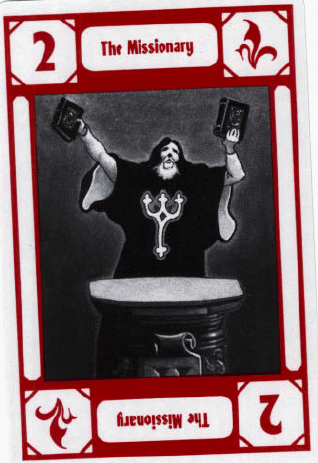
"The Abjurer's importance, four, is twice that of the Missionary, two. Together, they number six. We reveal a hexad."
"A triumvirate of evil has befallen the land. Vanquish them, and know peace.
Look within the Traitor to find the Beast.
Look within the Artifact to find the Anarchist.
Look within the Donjon to find the Necromancer.
[pause]
No - this is not correct..." [Kezia transposes The Traitor and The Beast]
"Along your journey hence, beware this card."
"But above all else, fear this."
Read Post
| 3
adventurers hailed
Labels: adnd, session recaps, tarokka
Friday, January 19, 2018
An example of player agency vs. DM narrative
Scribe:
Matt S
Recently, Sean and I were talking about the difficulty of starting new campaigns, in light of his session #1 kicking off in a little over a week. Do you begin with a mundane assignment for the PCs? A plot-driven story arc that forces the party down a specific path to "introduce" them to the setting? How much narration is OK? How much predestination should be tolerated?
I've self-debated these many times, and learned from past experience on several occasions. We discussed a hook where the PCs begin the campaign as captives in an arbitrary dungeon cell, without their equipment. Is this a reasonable thing to do to a party?
My answer is that most scenarios, including this one, are fine to incorporate into your game, if executed properly. Specifically, the DM should ensure that the party retains a meaningful degree of control over the session's outcome. The PCs should be participants and protagonists, not audience and onlookers to the DM's prologue. To elaborate, I described two ways that a DM might have the PCs-as-prisoners scenario play out.
In the first variation, the PCs awaken in a cell, clothed but lacking any weapons, armor, spellbooks, or equipment. They pass a day in confinement, devoid of opportunities to escape, but learning (from guards, other prisoners, etc.) of their surroundings, why they were captured, perhaps the identity of the mastermind who rules the dungeon: critical information that can be used later in the campaign. Shortly thereafter, a band of rescuers breaks into the cells, leads the PCs to their plundered wares, and shows them the way out. The party battles off a guard or two, but the instruction and heavy lifting are provided by the rescuers.
For the second variation, the PCs awaken in the same situation as the first. Early on, however, they're presented with a potential means of escape: a key slipped to them by a thief in an adjacent cell. The players deliberate on how to proceed; the more time that passes in the cell, the more information they garner from their surrounds. The session revolves around the party crafting and executing an escape plan, recovering their equipment, and making it out alive.
In variation #1, the DM likely ends up doing most of the talking throughout the session - mainly, telling the players what happens as the PCs tag along for the ride. In the second variation, however, the players control the pace, for their planning requires questioning the DM about the subtle details of the cell area, mannerisms of the guards, and demeanor of the other captives. They might spend time (even days) learning about the daily routines within the prison, when mealtimes and watch rotations occur, to figure out the optimal circumstances for breaking free. Do they try to get anyone else out with them? What about the thief who gave them the key?
At the end of variation #1, the players have bore witness to a grand escape, and feel relieved; at the end of variation #2, the players have orchestrated the escape itself, and feel accomplished.
In both variations, the DM starts with the same hook and progresses the campaign from the same point A to point B, but the player experience between the two varies greatly. As a player, I'd find myself disengaged at being an object of the DM's narrative in variation #1, whereas variation #2 would give me a sense of purpose from the beginning (despite the initial forced capture) and a substantial measure of fulfillment (not to mention camaraderie with the other players) upon executing a successful breakout. Variation #1 would leave me doubting whether I'd want to play in the DM's game again; variation #2 would leave me itching to find out what evil plans the party might foil next.
It all boils down to player agency, and enabling the players in your campaign to actually be players in your campaign, as opposed to merely observers. This is largely the stigma behind "railroading" in RPGs: it's not the presence of plot lines or story arcs that causes issues for most players, but the feeling that they, the players, were only invited to the table to consume the DM's narrative.
At the end of the day, AD&D characters are created to play the part of heroes. Let them.
Thursday, January 18, 2018
#3: The Prisoner
Scribe:
Jason Gunder
Ashes cold, we search the ruined buildings of
Shadfeld. It appears as if some time—hours,
perhaps days—has passed since the conflict with Korvich. The town is empty, the bodies of those slain
in the attack taken or otherwise mysteriously disappeared. Tussugar and Rould do not take the news of my
acquaintance with Korvich and the beast Carcerus well; reasonable, and to be
expected.
We part ways with Tussugar in anger, each to search the ruins
of the town on our own. Audric & I
notice a plume of smoke in the distance, coming from a battered cottage. We see shadows and a hearthfire within, and when
we enter, Audric is held at knife-point.
The occupant is revealed to be Kezia, and after announcing ourselves and
our intentions, she bids us enter.
Kezia is a young woman, perhaps in her late teens, in tattered clothing with a red
scarf; she bears blood upon her face and knife, though whether it is hers or
that of the attackers, we are unable to tell. She looks exhausted and unkempt. She indicates that she encountered Shadfeld’s attackers and cut one of
them, so the latter is most likely. She appears to be a wise woman, perhaps a shaman, though
of what tribe or people I cannot tell.
She offers a reading, taking blood from both of our palms with her
knife. I have seen similar rituals in
Icewind Dale conducted with clotted blood, organs and bone. Kezia uses a deck of painted cards.
Her cards reveal the Trader and the Druid; the former
perhaps a reference to Erathmar, the latter certainly Damyca, which are
overlapped by the Missionary and the Abjurer—almost certainly Audric and myself. She indicates that it forms a “hexad”, a term
I have not before encountered.
She reveals six more cards. She tells that a triumvirate of evil has befallen the land. The Traitor and the Beast—the latter likely Carcerus. The Artifact—perhaps the ring Audric carries—and
the Anarchist. The Donjon and the
Necromancer—perhaps Korvich, but I did not know my mentor to possess such dark
arts. Kezia announces that we look to
the former to find the latter, later reversing her placement of the Traitor and
the Beast.
Two final cards are revealed: the Myrmidon, of which we
are to beware, and the Marionette, which we are to fear above all else. The meaning of both are a mystery. I offer a reward in exchange for her gift of
knowledge, but she declines. We take our
leave of Kezia, fearing for the safety of Tussugar and Rould. The decision is made, after some gruff talk,
to travel to Carrock, 30 miles to the east.
We depart the next morning in silence.
On the route to Carrock, Audric and I discuss the meaning
of Kezia’s reading, and we are left with more questions than answers. In the afternoon, we encounter a pair of
riders, dragging behind them an unconscious man.
They respond to our hail, claiming they ride from Carrock
to Shadfeld. We share the news of
Shadfeld’s destruction, which is not believed.
The men—Bartley and Emmet—believed their prisoner to be from Shadfeld. Apparently he is a lunatic, having made claims
of demons before attacking their sister.
This form of punishment does not sit well with me, however, and care is
taken to revive the prisoner, who seems malnourished beyond the extent of his
captivity.
In speaking with Tussugar of Shadfeld’s fall, they relinquish
control of the prisoner—temporarily, perhaps—to me. It is my hope that more can be learned of
this man—and his visions—to determine whether he is indeed crazy, or whether he
possesses some knowledge that we may need.
Read Post
| 2
adventurers hailed
Labels: journal, session recaps
Wednesday, January 10, 2018
Malaran rites
Scribe:
Matt S
Upon finding a few brief moments of reflection, Zeb considers the attack upon the village, the appearance of Carcerus, and Korvich, the priest under which he, Zeb, once served as an acolyte.
The cultists have traveled far, hundreds of miles and more, in his pursuit, and as such Zeb concludes that Korvich has executed the Malaran rite of vorishnaad, the exorcism of oneself from the cult to form a separate sect. Vorishnaad is typically carried out under circumstances surrounding aclupar, or "reason for being." Aclupar serves as the driving force behind the new sect, guiding its actions and motivations until fulfillment is achieved.
Zeb fully believes that he is the new cult's aclupar, and that Korvich will not rest until Zeb's blood is spilled before his former master in dramatic fashion. A trivial slaying will not suffice, and the presence of Carcerus amid the group is a fearsome indicator of the magnitude of the high priest's will.
![]() |
| Carcerus, the "Black Devil" (Attribution) |
Zeb fully believes that he is the new cult's aclupar, and that Korvich will not rest until Zeb's blood is spilled before his former master in dramatic fashion. A trivial slaying will not suffice, and the presence of Carcerus amid the group is a fearsome indicator of the magnitude of the high priest's will.
#2: The Razing
Scribe:
Jason Gunder
After constructing a hasty bier for Damyca, we rest upon
a nearby hilltop, our minds full of doubts and questions. In the morning, we prepare what spells we
have at our disposal to discover the nature of the runes. The runes are not etched, but rather applied
seemingly by magic to the cave walls.
The spell is revealed to be dimension door; potent, but focused and
limited teleportation magic.
Discussion occurs regarding the findings, as well as
potential plans. With little to go on,
the decision is made to return to Shadfeld with Damyca’s corpse. Tussagar believes Tyoness might be able to
discern more about Damyca’s demise.
Precious time is taken during our return for me to skin
the bear felled by Tussagar the previous night.
Though our travel is unobstructed, the time proves a dear expense; Shadfeld
is aflame upon our return. My first
thoughts turn towards Erathmar and the merchant’s safety.
“Carcerus, the Black Devil”: A pitch black, bipedal wolf
creature associated to the Beast Cults; a shapechanger. Carcerus leads (presumably) the band currently
setting flame to Shadfeld.
Alerting Tussagar and Audric to the danger, we rush to the church, where we find Tyoness being held captive by Korvich, my mentor in the Beast Cults.
I roar a challenge to Carcerus, but the beast-kin does
not respond, instead mauling the magically held form of Tyoness. Korvich assaults me with magic, attempting to
force me to bow to his will, but I struggle to resist the spell. While Carcerus and Tussugar trade blows,
Korvich casts again, stealing my will to fight, and planting the seed of doubt
that leaving the cult was a mistake, and that rejoining is the proper course of
action.
Fortunately, Audric is there to talk sense into me, and
suggests flight from the conflict. We flee,
but as we do the fires within town fade, as if by some mysterious magic, and
except for fleeting shadows and far-off cries, it looks as if the battle has
abated, the fires having run their course.
We follow cries back to the church, where we find Rould standing over the injured Tussugar, with Tyoness nearby, dead. The ashes of nearby buildings are cold, as if hours or even days have passed. Tussugar is rejuvenated, and we ponder the situation at hand.
Read Post
| 2
adventurers hailed
Labels: journal, session recaps
Monday, January 8, 2018
Session #1, Zeb's Notes
Scribe:
Jason Gunder
Much of this was already elaborated upon in the recap of the session, but I'd like to include Zeb's notes as they were written during the actual session (corrections made for spelling and post-session clarifications). I may eventually record some clue that our DM fails to include in his narrative.
Audric: Crusader of Mystra; seeks out rumors of magic or
misuse of magic, investigates as part of his responsibilities to a loose order
of like-minded individuals
Erathmar: Caravan leader, weathered and
battle-hardened. Not particularly
wealthy. We have a mutually beneficial
arrangement to guard his wagons during his travels, in return he watches our
backs. Currently heading towards Mirabar
from points west. Our relationship is
very much “don’t ask, don’t tell” about our pasts.
Shadfeld: Small village along the river, mostly farmers
and such. Has a small
multi-denominational temple, run by Tyoness.
Insignia of a gauntlet on her blouse.
Rould:
Hunter, could be related to Tyoness.
Damyca: Druid that had a
premonition of evil coming to Shadfeld; disappeared several days ago to seek
out information at Moonglow Cave ~2 days to the north of Shadfeld.
Tussugar: Village leader,
dwarf. Founder of Shadfeld. Unimpressive until he puts on his armor; he’s
obviously a warrior of some significance.
In the past, made much of his career fighting goblin-kin in the Spine of
the World. Purchased a magical ring from
the last traveling merchant that has unknown powers.
Barish: Friendly hunter,
grizzled. Gave us info about Moonglow
Cave, and some confidence that Rould is an effective woodsman.
Korvich: Priest of Malar that was my introduction to the
faith. Spent several years together
before leaving the beast cult. Closest
to Zeb, so also the most enraged and upset by his departure.
Typical camp procedure: Alarm spell affects a 20’ cube, I
use that with the password “Fang” for my companions. At four points each 20’ from the camp, I
affix tiny bells to string on trees and brush (especially on any obvious
approaches). When there is a fire,
always leave enough burning brands so that each person can grab one in case of
an emergency.
Traveled with Rould and Tussugar to Moonglow Cave. Along the way, was attacked by an enraged
cave bear which nearly slaughtered Tussugar, until the dwarf changed into a
bear himself. Tussugar, in bear form,
killed the enemy bear before reverting to his normal form, though fell into
unconsciousness and would not awaken until the following morning.
Upon questioning him, he revealed that he purchased a
mysterious ring from the last traveler in Shadfeld, who claimed it was looted
from a fallen dwarf. It’s worth questioning
Tussugar more on the matter—who was this traveler? Who was the dwarf from whom it was looted,
and where exactly was it found? What
were the apparent circumstances of the dwarf’s death?
With no answers for now, at least, Audric took the ring
and we continued to travel to Moonglow Cave.
Upon arrival, we discovered the withered corpse of Damyca, apparently
drained of blood and life though no serious wounds were apparent. There were scratch marks, as of those of a
great cave bear, on the walls, as well as mysterious runes deeper into the
cave. Rould claims that it could
possibly be stirges that drained her, but I have my doubts. It’s conceivable, however, and will remain
the most likely scenario until some other evidence is discovered. I intend to search Damyca for anything
useful—grim, but necessary—as well as for any other signs of what may have
happened. The scratch marks on the cave
wall are also worth investigating—why? Perhaps
this was formerly the cave bear’s roost, and it used the wall to sharpen its
claws? If possible, I’d like to memorize
or write down the runes (assuming there aren’t too many). We’re going to rest on a nearby hill and
attempt to read magic on the runes in the morning, and if no other clues are
discovered, we intend to return to Shadfeld with the bitter news.
Read Post
| 3
adventurers hailed
Labels: journal
Sunday, December 31, 2017
Moonglow Cave: discoveries and dialogue
Scribe:
Matt S
For convenience, here are the clarifications I provided after the session over email.
- It does seem possible that stirges (or similar creatures) could have killed the druid. Though the cave bears no immediate signs of being occupied, you find droppings similar to those of birds fairly littering the floor. Stirges (as Rould explains it) tend to move from place to place as food supplies are exhausted. Upon closer examination, Damyca's dead skin looks patchy and discolored - perhaps residual stains from bloodletting? If she was attacked in such a way, she was likely taken completely by surprise.
- It stands to reason, too, that the claw marks on the walls could have been made by the same "cave bear" that attacked the party in the forest, perhaps having been previously driven out by stirges, other enemies, or even Damyca(?). The "cats on furniture" hypothesis seems to fit the nature of the scratch marks.
- No other tracks are apparent, to Rould or anyone else. The area around the cave mouth is rocky and dry, ill-suited for leaving footprints and the like.
- The runes aren't so many, and Zeb can certainly begin scrawling them onto parchment, if he's willing to take some time before the party leaves.
- The dwarf has a stubborn air about him when questioned about the ring, but this seems more rooted in his own pride than a result of magical influence. He remembers not (or declines to say) the name of the man he acquired it from; the piece was unique, dwarvish in make, and he suspected (but had no way of proving) that it harbored some form of protective enchantment. In fact, he hadn't donned it at all until the morning of the group's departure. The ring was supposedly recovered amid a lot of plundered treasure from an abandoned mine.
- The trader was traveling with a larger mercantile company from Mirabar, which was following a similar route along the River Mirar, around midsummer. He remembers the group, given that few travelers pass through the village even during the height of trade season, but knows (or admits) little else.
- Damyca's body seems barren of anything useful. A nomadic druid, she carried a staff, a few basic provisions, and lacked anything magical (unless such valuables have already been plundered).
Feel free to post comments to this thread with any additional questions.
Read Post
| 1
adventurer hailed
Labels: adnd, fr, session recaps
Friday, December 29, 2017
#1: Shadfeld
Scribe:
Matt S
Our new campaign opened upon Shadfeld, a woodland village along the River Mirar in the lower foothills of the Spine of the World. The characters, Audric and Zeb, a Mystran crusader and refugee Malaran cultist, had arrived in escort of a fur trader named Erathmar, having traveled east from an outpost known as West Tower and, previously, Mirabar.
Erathmar, a retired adventurer in search of rare ore from the nearby mountains, bade the PCs to take leave during their stay; soon after, their presence was sought by Shadfeld's high priestess who, along with a hunter named Rould, questioned the party's intentions and origin. The duo explained that a local druid had recently fled after imparting a premonition that great evil would descend upon the village. The druid, Damyca, served as a pillar of protection for the area, and her departure to seek meditation at a site known as Moonglow Cave spawned concern, both for her vision and in her failure to return after several days. Pledging their aid, Audric and Zeb offered to accompany Rould and Tussugar Grim, dwarf and village marchion, in search of the missing woman.
A day's travel took them deep into forested terrain, where they set a defensive camp in the bowels of a low valley. During the night, their alarms were triggered by an enormous bear that assaulted them from the darkness. Unable to run, they fought, Tussugar exchanging blows from the creature's paws with a gruesome cut from his rune-encrusted dwarven axe. Then, inexplicably, Tussugar dropped his weapon and convulsed, his stocky form melding into that of a bear, equal in size and strength to their aggressor. As the allies rained missiles upon the attacking bear, the transfigured Tussugar crushed its neck with his mighty jaw. The creature fell limp and Tussugar convulsed again, his body contorting back to that of a dwarf, ere he collapsed. The others, distraught, guarded the camp until sunrise.
Tussugar awoke to interrogation, and though he acknowledged what had transpired, he failed to explain his transformation, gruffly asserting that the company should continue on. After persisted questioning, however, the dwarf conceded possession of a pewter ring, purchased from an ore trader many weeks prior, which he suspected to be the source of the previous night's event. Using detect magic, Audric discerned an overwhelmingly powerful aura emanating from the artifact.
That eve, Moonglow Cave came within view, a rocky outcropping emanating a blue luminescence atop a small peak amid the forest. The company approached, discovering the blood-drained husk of Damyca inside its mouth. Too, they found claw marks from some massive creature and, in the cave's depths, undecipherable runes scribed in an unknown language.
DM's Commentary
Sean, Jason, and I have been playing at the idea for this campaign for a long time, so it's great to see it finally kicked off. Zeb and Audric are already deep characters, with aspects that extend well beyond anything written above. I think this session was a decent start, despite a bit of strangeness and quite a lot unanswered. Hopefully the player's agree!
It's Really Not Lord of the Rings
I don't love D&D games having a MacGuffin; I realize that the plundered scepter felt like one during the last campaign, and that the sudden appearance of a transcendent ring ushers in similar vibes here as well. I don't stage the exact way sessions will unfold (even first sessions!), and there were elements of chance involved that I can't elaborate on presently, but that definitely contributed to much of what transpired in-game. You guys may just have to take me at my word, for now...
Read Post
| 7
adventurers hailed
Labels: adnd, fr, session recaps
Tuesday, December 26, 2017
New campaign prep
Scribe:
Matt S
Think I'm about ready for Thursday night's new campaign. We're splitting our players into different games, with Sean, Jason, and me setting off on our own. Not much to disclose yet, but planning is coming along well. I'll continue to use this site to chronicle our sessions; anyone not playing in the offshoot can unsubscribe from posts if they become overbearing.
Read Post
| 0
adventurers hailed
Labels: adnd
Wednesday, December 6, 2017
Company Charter
Scribe:
Jason Gunder
In an effort to align some of our character backstories, motivations, and to provide some top-level direction to justify the existence of our jolly band of adventurers, I think it's worth investigating the idea of a company charter. This isn't so much a list of rules or regulations as it is a general statement of purpose--within the charter, characters can certainly have individual motivations, and we can even act against the charter's purpose as a group when the situation demands; it's more an underlying set of principles that we share that can help guide group decisions.
The charter need not be set in stone. One of the great things about roleplaying games is that characters develop and change over time, and so to should our charter change to suit great events that befall us or changes in outlook or perception.
One underlying theme, at least in some of the characters currently being developed, is magic or the pursuit of magic. As such, I put forth the following suggestion for our company charter, at least at the beginning.
- Magic and the produce of magic, be it spells or items or creatures, are beyond the comprehension of most common folk. As adventurers possessed of unique abilities, we are responsible for protecting the common folk from magic that would do them harm.
- Magic is ancient, and current civilization is built upon the ruins of great magical cultures. Relics of these cultures sometimes surface, and it is of great interest to us to pursue and secure the safety of these items, lest they fall into the wrong hands.
- Magic is a powerful and sometimes unpredictable force; when magical mysteries manifest, we are responsible for discovering the source of these mysteries, and to control them when necessary lest they bring harm to others.
- Not all magic is benevolent; magic whose sole purpose is to harm should be pursued, controlled, and when possible destroyed.
This should give our DM some fuel for adventures, especially ways to kick off new plotlines. It should also provide some direction when confronted with decision points, while allowing us the flexibility to pursue our individual moral direction.
Do you have any suggestions to add to or alter the direction of the company charter?
Tuesday, December 5, 2017
The Crusader (creating a new character class)
Scribe:
Matt S
For the next campaign, Sean and I have been discussing terms for a new character class that fits the mold he wants to play. The 2e FR accessory Warriors and Priests of the Realms provides a write-up for a class called the "Crusader," which matches Sean's idea thematically (a combat-oriented missionary priest with ties to the goddess of magic) but comes with some mechanical baggage that we're struggling to get past. As a result, we turned to the 2e DMG (pp. 22-23) which describes a framework for creating a new character class from the ground up. Here's our current working model. Each trait listed below has a corresponding modifier; the modifiers are aggregated to determine the XP advancement table.
Crusader (work in progress)
- Must be human (modifier: 0)
- Priest combat values (0)
- Priest saving throw table (0)
- d8 hit dice (+1)
- All armor allowed (0)
- All weapons allowed (0)
- +2 hp per level beyond 9th (+1)
- Cast three spheres of priest spells (+6)
- Learn and cast one school of magic (+3)
- No ability to turn undead (0)
- Use magical items allowed to priests (+1)
- Must be good-aligned (-1)
- Has particular ethos that must be obeyed (-1)
- Cannot keep more treasure than can carry (-0.5)
- Cannot own more than 10 magical items (-0.5)
Modifier total: 9
Experience levels (mage and cleric listed for comparison):
| Level | Crusader | Mage | Cleric |
| 1 | 0 | 0 | 0 |
| 2 | 1,800 | 2,500 | 1,500 |
| 3 | 3,600 | 5,000 | 3,000 |
| 4 | 7,200 | 10,000 | 6,000 |
| 5 | 18,000 | 20,000 | 13,000 |
| 6 | 36,000 | 40,000 | 27,500 |
| 7 | 72,000 | 60,000 | 55,000 |
| 8 | 135,000 | 90,000 | 110,000 |
| 9 | 252,000 | 135,000 | 225,500 |
The crusader's XP advancement begins much more favorably than the mage and only slightly worse than the cleric, but over time requires greater totals at higher levels of play. I think this is fair and appropriate for a character with multiple types of spellcasting (for anyone concerned about balance with other classes).
One major facet of the class that we need to figure out is how wizard spellcasting should be implemented. The reason for the ability to cast a single school of wizard spells (Sean is choosing conjuration/summoning) is the character's devout ties to Mystra. As such, I think there are two main approaches to consider:
Creating a new class isn't something I've dabbled in before, and it's important that the end result is reasonably fair and balanced (at least, as balanced as anything in AD&D). Interested to hear anyone else's take; the class as constructed seems relatively strong and versatile at low levels, but suffers from a slower rate of advancement the longer the campaign goes on.
One major facet of the class that we need to figure out is how wizard spellcasting should be implemented. The reason for the ability to cast a single school of wizard spells (Sean is choosing conjuration/summoning) is the character's devout ties to Mystra. As such, I think there are two main approaches to consider:
- The crusader casts priest spells as a priest and wizard spells as a wizard. That is, the crusader's priest and wizard spell slots are independent (the character effectively gets both); bonus spells apply only to the priest spell slots; wizard spells must be learned through study as opposed to prayer; and armor cannot be worn when casting wizard spells (same as a wizard or bard). This treats the character as a multi-classed cleric/mage in terms of spellcasting.
- The crusader casts all spells as a priest. That is, all spells are gained through prayer, using the character's single set of priest spell slots; the wizard spell school is treated as just another priest sphere; no spellbook is needed and no armor restrictions are applied.
I'm not sure that I have a preference, yet. Mechanically, there are trade-offs, mainly that option #1 gives the character more total spell slots, while option #2 removes the wizardly armor and spellbook restrictions. I think either approach can be justified in-game.
Creating a new class isn't something I've dabbled in before, and it's important that the end result is reasonably fair and balanced (at least, as balanced as anything in AD&D). Interested to hear anyone else's take; the class as constructed seems relatively strong and versatile at low levels, but suffers from a slower rate of advancement the longer the campaign goes on.
Sunday, December 3, 2017
Party creation recap and next steps
Scribe:
Matt S
Revving up for a new campaign in the wake of the recent TPK, this post is a summary of what we know so far.
- The selected classes are transmuter, ranger, cleric/abjurer (dual-classed), and "crusader" (2e fighter/cleric kit, pending final approval)
- It appears that all PCs will likely be human
- The party has agreed on a good-aligned moral compass, rejecting thievery but with a possible anti-establishment penchant (e.g., Robin Hood analogy); the overall party alignment looks to be "neutral good"
- All ability score rolls are completed
- Starting XP will be 5,000 per character (prime requisite bonuses apply)
- Max hit points are assumed for 1st level; all other levels should be rolled; all 1's may be re-rolled
With two character concepts rooted in the Forgotten Realms pantheon, it's reasonable to assume the use of FR gods for anyone concerned with religion. For the sake of backgrounds, while I'm withholding any formal setting announcement until we begin, assume that the starting locale will be a small village in a fantasy realm akin to where the previous campaign left off. In other words, assume forests, mountains, a nearby mining city, a coastline within reasonable distance, etc. The party is assumed to have traveled to this location together leading up to the start of the campaign.
If more detailed information than this is needed, it may be best to pose specific questions or pitch me your background ideas for me to help work them in. Backgrounds are not of the greatest importance in the big scheme of things.
First Session Date
I'd like to get a first session in before the end of December. While the holidays are a busy time, we should be able to find one out of 25+ evenings that three households can be brought together. If it's easiest to plan something between Christmas and the new year, when many of us are off work, that's certainly doable.
All for now!
All for now!
Subscribe to:
Posts (Atom)


